High-End Business Card Finishes That Make a Lasting First Impression
In a world where professional networking increasingly happens through LinkedIn messages and digital introductions, the physical business card has become a rarer and more powerful touchpoint. When you do hand someone a card, it has an outsized opportunity to create an impression, positive or negative, about your brand and your attention to detail. A premium finish is not vanity. It is a calculated use of the tactile dimension that digital communication cannot replicate. This guide covers every significant premium finish available, what each one communicates, and which contexts justify the investment.
Why the Tactile Experience of a Business Card Matters
Research on sensory marketing consistently shows that unusual tactile experiences create stronger memories than familiar ones. When someone picks up a business card with a finish they have not encountered before, a velvety soft-touch surface, a raised debossed logo, a logo that catches light differently from the rest of the card, their brain registers the experience as noteworthy. That registration creates a stronger memory association with your brand than a card they process and file without any sensory pause.
This effect is particularly powerful in high-stakes networking contexts, industry events, client meetings, pitch presentations, where multiple people are exchanging cards and the opportunity to differentiate through design and finish is real and measurable. A card that someone picks up and examines more closely, turns over, or comments on has achieved something that a forgettable card never will: it has made the brand memorable before the conversation has fully begun.
Soft-Touch Laminate: The Highest-Impact Finish at a Reasonable Price
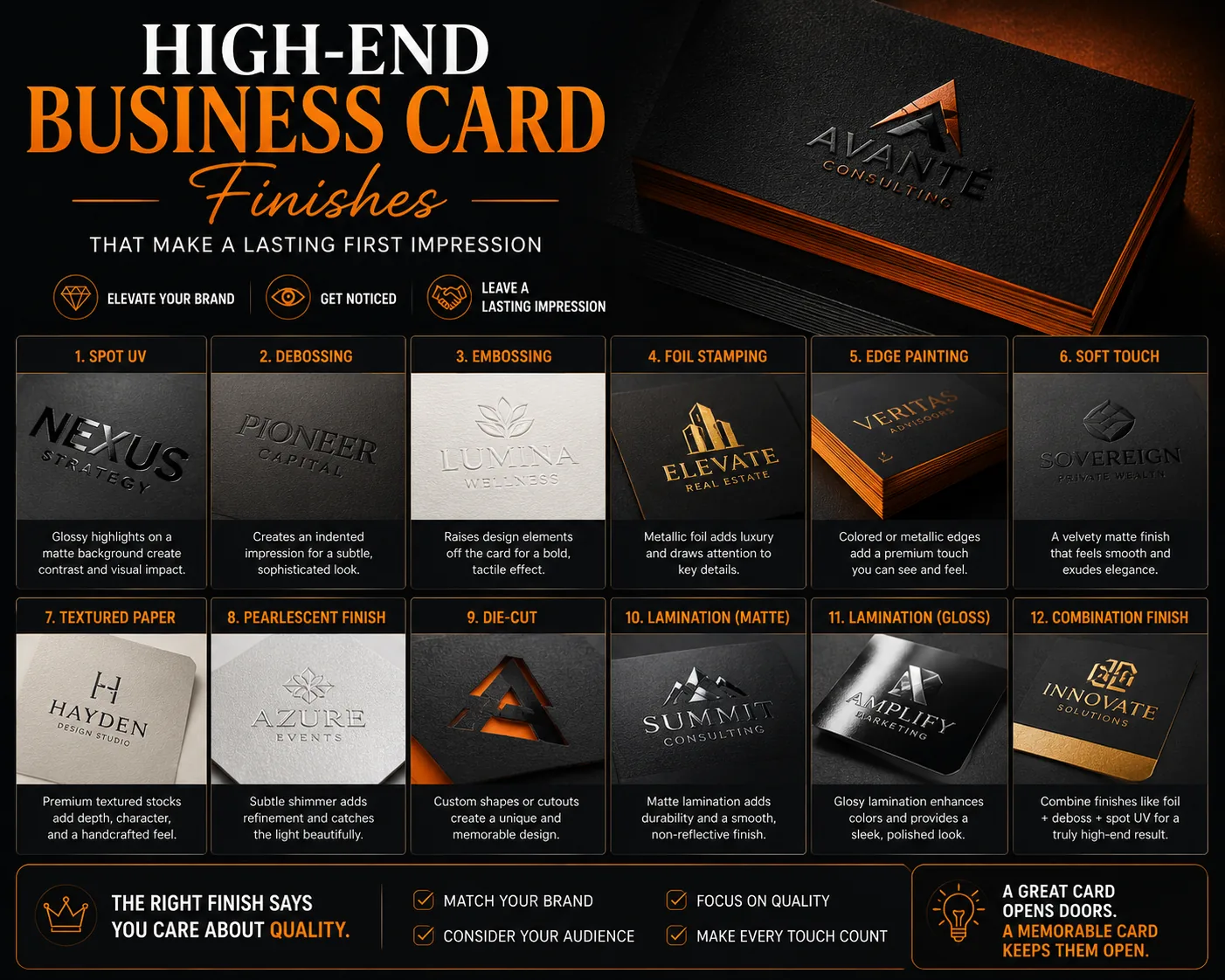
Soft-touch laminate, also called velvet laminate or suede laminate, applies a coating to the card surface that creates a velvety, slightly rubberized tactile experience. It is the finish most consistently described as memorable by recipients who encounter it for the first time. Unlike gloss or matte laminate, which are familiar to anyone who has held a business card, soft-touch creates a genuinely novel sensation that most people have not associated with a business card before.
Soft-touch is most effective on cards that use a bold, design-forward layout, dark backgrounds, strong typography, minimal elements. The finish makes colors appear slightly deeper and more sophisticated than on standard matte stock. It also provides excellent fingerprint and smudge resistance, which is practically valuable on dark-background cards that would otherwise show every touch.
The price premium for soft-touch over standard matte laminate is typically 30 to 60 percent on a per-card basis, making it accessible for most professional contexts.
Spot UV Coating: Creating Visual Drama Through Contrast
Spot UV coating applies a high-gloss varnish to specific areas of the card surface while the rest of the card remains matte. The contrast between the high-gloss element and the surrounding matte creates both a visual effect, the coated area catches light dramatically at certain angles, and a tactile effect, as the raised glossy surface is perceptibly different from the matte background under fingertip contact.
Spot UV is most powerful when applied to a single, strategically chosen element, typically the logo mark alone, or a key graphic element. When applied to large areas or multiple elements, the contrast effect is diluted and the result looks more like a glossy card with matte sections rather than a purposeful premium treatment. Restraint is the key to effective spot UV: less coverage, more impact.
Spot UV requires that your logo and design elements be supplied as vector files with precise knockout paths that define exactly where the UV coating will be applied. Ensure your designer prepares a separate UV spot layer in the print file when ordering this finish.
Foil Stamping: Communicating Luxury Through Metallic Sheen
Foil stamping applies a metallic or pigmented film to specific areas of the card using heat and pressure. Gold and silver foil are the most classic choices, immediately communicating luxury, craftsmanship, and premium positioning. Copper and rose gold foil have become increasingly popular for contemporary premium brands seeking a sophisticated but not traditional feel. Holographic foil creates a rainbow iridescent effect that is more playful and works well for creative and entertainment brands.
Foil stamping is the finish most directly associated with premium pricing in the minds of recipients. A gold-foil-stamped logo on a dark card communicates exclusivity and high value as clearly and immediately as any visual signal available in print media. It is the appropriate choice for luxury goods brands, high-end professional services, and any context where the card will be exchanged with clients whose purchasing decisions involve significant investment.
Foil stamping is a separate production process from printing and adds significantly to card cost, typically $0.30 to $1.00 per card on top of printing costs depending on coverage area and foil type. It requires precise setup and clean vector artwork for the foil elements.
Embossing and Debossing: Tactile Depth Without Color
Embossing creates raised elements by pressing the card stock from behind, producing a three-dimensional protrusion above the card surface. Debossing presses from the front, creating recessed elements pressed into the card surface. Both effects are purely tactile, they add depth and dimension without the addition of any ink, varnish, or foil, relying entirely on the physical manipulation of the card stock for their effect.
Debossing a logo mark on an unprinted area of the card, particularly effective on thick natural-texture stocks or on the back of a card with a clean front design, creates an impression of understated luxury that is widely regarded as the most refined finish available. The effect is most powerful on card stocks of 400gsm or heavier, where the stock has enough fiber density to hold a crisp impression without cracking.
Choosing the Right Finish for Your Brand Context
The right finish is the one that most accurately signals your brand’s positioning to the specific people who will receive your card. A soft-touch card with a bold typographic design communicates contemporary creative premium. A thick duplex card with gold foil and minimal design communicates traditional luxury. A debossed logo on natural kraft stock communicates artisan authenticity and environmental consciousness. An energetic full-color design with spot UV communicates design confidence and visual creativity.
Before choosing a finish, define clearly what you want a recipient to feel in the moment they pick up your card. Then select the finish that creates that feeling as directly and economically as possible.
Frequently Asked Questions About Premium Business Card Finishes
What is spot UV coating on a business card?
Spot UV coating is a glossy varnish applied to specific areas of a business card, typically the logo or a key design element, while the rest of the card remains matte. The contrast between the glossy raised element and the surrounding matte surface creates a sophisticated visual and tactile effect. It is most effective when applied to a single focal element like a logo mark.
What is soft-touch laminate and why is it so popular for premium cards?
Soft-touch laminate is a specialty coating that creates a velvety, slightly rubberized tactile experience unlike any standard card finish. The unusual tactile experience creates a stronger sensory memory associated with the brand, making soft-touch cards among the most memorable options available at a non-luxury price point.
What is the difference between embossing and debossing on a business card?
Embossing presses the card stock from behind to create a raised element above the card surface. Debossing presses from the front to create a recessed element pressed into the card surface. Both create a tactile element immediately noticed when handling the card. Debossing is typically considered more refined and works particularly well with minimal designs.
What paper weight should I choose for a premium business card?
Premium business cards use paper stock of 350gsm to 600gsm. At 350gsm the card feels solid and professional. At 400gsm to 450gsm it communicates premium quality through physical weight alone. At 600gsm, achieved by laminating two 300gsm sheets together, the card creates an immediate impression of luxury that is difficult to match in any other way.
Is it worth investing in premium business card finishes?
Premium finishes are worth the investment when the card will be exchanged with prospects or clients where the quality signal matters to the purchasing decision. For professionals in competitive markets, consulting, law, finance, luxury goods, architecture, a premium card differentiates you at a moment of direct personal contact that few other marketing channels can replicate.