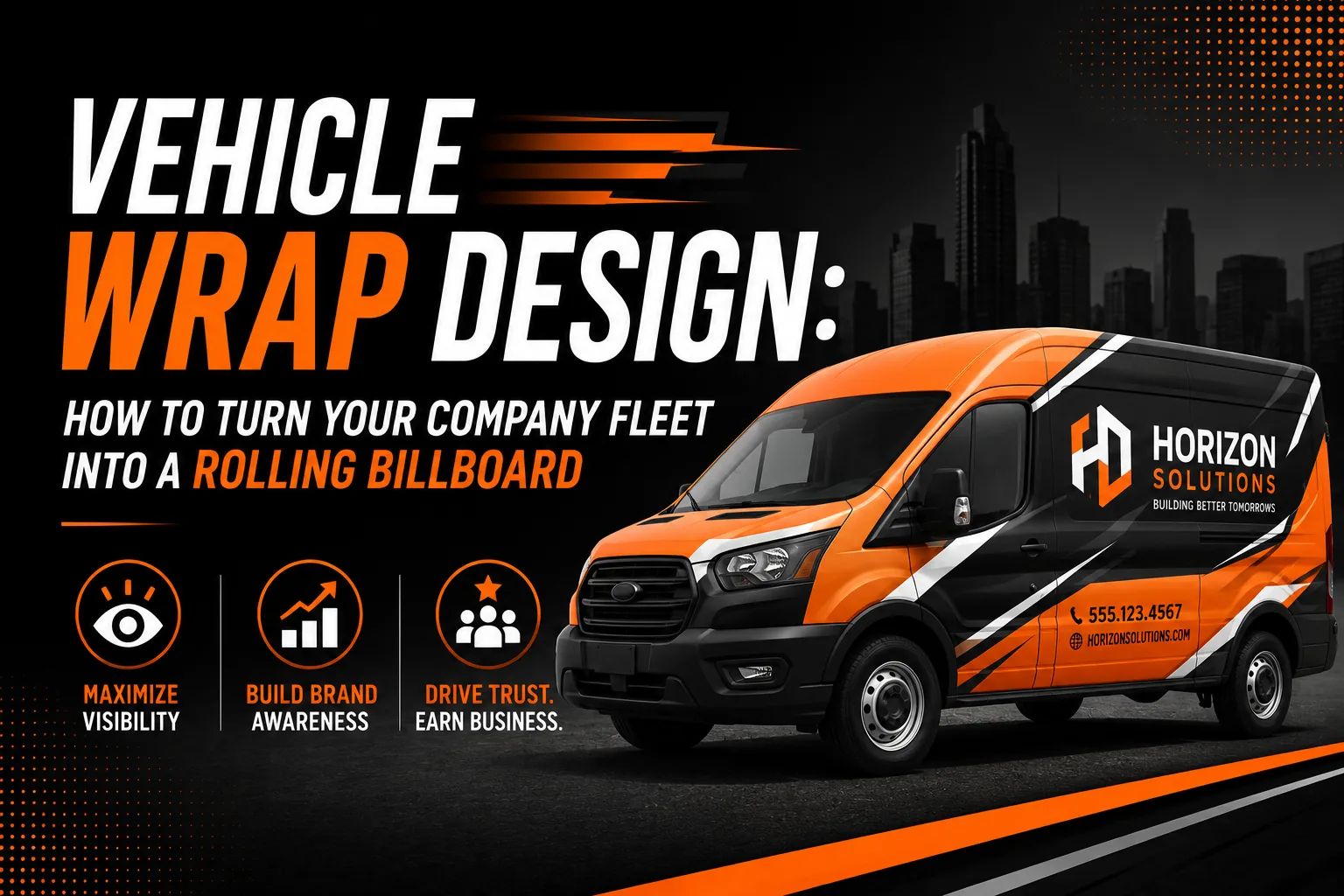
Vehicle Wrap Design: How to Turn Your Company Fleet Into a Rolling Billboard
A professionally wrapped commercial vehicle generates an estimated 30,000 to 70,000 visual impressions per day in urban and suburban environments, every commuter, pedestrian, and resident who sees it while it is parked on a job, driving to a site, or stopped at a traffic light. Over five to seven years of vehicle lifespan, a single wrap produces millions of local brand impressions at a cost per impression that no other advertising format can approach. For service businesses operating in a defined geographic area, vehicle wraps are among the most cost-effective marketing investments available. This guide covers everything you need to know to design a wrap that actually works.
The Three-Second Rule: Designing for Real-World Viewing Conditions
Vehicle wraps are viewed under conditions that are fundamentally different from any other advertising medium. The viewer is typically moving, driving or walking past the vehicle, and has three to five seconds of viewing time at most. They are not choosing to engage with the message. They are receiving it passively, while simultaneously navigating their own movement and environment. This constraint defines every design decision that should be made for an effective vehicle wrap.
Everything on the vehicle wrap must communicate in that three-to-five second window or it does not communicate at all. A list of seven services, a lengthy tagline, a social media handle, fine print about licensing, and a multi-color gradient background all fail the three-second test because they require more time and attention than a viewer in motion can provide. The most effective vehicle wrap designs contain three to four elements: the company name, a one-line descriptor of what the company does, a phone number or website, and a visual background that makes the vehicle recognizable from any angle.
Visual Hierarchy at Vehicle Scale
Vehicle wraps have a unique visual hierarchy challenge: the vehicle is seen from multiple angles simultaneously and in motion. A design that communicates well from directly behind or to the side must also communicate from three-quarter rear views, from across a parking lot, and from the perspective of a pedestrian walking past. The largest, most prominent text element, the company name, must be legible from all of these angles without requiring the viewer to orient specifically to read it.
The company name should occupy the single largest text position on the vehicle, typically on the rear doors or side panels, sized to be readable from 30 to 50 meters. The descriptor or service category should be visibly secondary, clearly readable but not competing with the company name for visual prominence. The phone number or web address should be in a third, clearly legible tier. No other text elements are necessary or beneficial at vehicle scale.
Color Strategy for Vehicle Wraps
Color choices for vehicle wraps must account for the vehicle’s existing color, or the decision to cover it completely with a background color. A full wrap that changes the vehicle’s background color provides the most design control and typically the strongest visual impact. A partial wrap that works with the vehicle’s existing color is more cost-effective but more constrained in its design options.
High contrast between the background and text is essential, even more so than in static signage, because the viewer has less time to decipher low-contrast information. White text on a dark background, or dark text on a white or light background, are the highest-legibility combinations for vehicle applications. Color photography used as a background must not interfere with the legibility of the text overlaid on it.
From a brand differentiation perspective, choosing a vehicle wrap color scheme that is distinct from competitors’ vehicle colors in your local market creates immediate recognition. If every other plumber in your area drives white vans with blue lettering, a deep green background with white text makes your vehicles immediately recognizable and memorable in a way that blending in never achieves.
File Preparation for Vehicle Wrap Production
Vehicle wrap production requires specific file preparation that differs from standard print production. The wrap company will provide a vehicle template file, a scaled diagram of the specific vehicle make, model, and year showing panel dimensions, door seams, window positions, wheel arches, and hardware cutouts. All design work must be positioned relative to these template elements to ensure the printed wrap, once installed, aligns correctly with the vehicle’s physical features.
Logo files must be provided in vector format (AI or EPS) regardless of how they will appear in the final design. Background photographs and graphics used in the wrap must be supplied at minimum 100 DPI at actual print size, which for a full-size van means source images of 3,000 pixels wide or more. Standard web images at 72 DPI or 96 DPI are completely inadequate for vehicle wrap production and produce visibly blurry results when printed at vehicle scale.
All fonts used in the design must be either converted to outlines before file submission or supplied as font files alongside the design file. Fonts not available on the wrap company’s production systems will be substituted with a default font, potentially changing the typographic appearance of the entire design.
Partial Wraps: When They Make Sense
Not every vehicle needs a full wrap. For businesses where the vehicle is also used personally, where the brand identity may change in the near term, or where budget constraints make a full wrap impractical, a partial wrap is a legitimate alternative with specific advantages and limitations.
A partial wrap covering the rear panels and side rear sections, typically 60 to 70 percent of the vehicle surface, can achieve most of the visual impact of a full wrap at 50 to 60 percent of the cost. The key is designing the partial wrap to appear complete and intentional rather than like a full wrap that ran out of budget. A strong background color that wraps fully around the rear of the vehicle, with the vehicle’s original color visible on the cab and front doors, can look deliberate and professional when designed as a cohesive system.
Frequently Asked Questions About Vehicle Wrap Design
How much does a full vehicle wrap cost for a commercial van or truck?
A full vehicle wrap for a standard commercial van or pickup truck typically costs $2,500 to $5,000 including design, print, and installation. Partial wraps cost $1,200 to $2,500. The cost per impression over the wrap’s lifespan makes it one of the most cost-effective local advertising formats available to any service business.
What file format does a vehicle wrap company need?
Vehicle wrap companies require vector files for all logo elements and text, typically AI or EPS format. Background graphics and photos must be supplied at a minimum of 100 DPI at actual printed size. The wrap company will typically provide vehicle-specific template files showing panel dimensions, door handle cutouts, and other features that must be accounted for in the design.
How long does a vehicle wrap last?
A professionally installed wrap using high-quality cast vinyl typically lasts 5 to 7 years in normal use conditions. Factors that reduce lifespan include regular outdoor parking in direct sunlight and commercial vehicle washing with abrasive brushes. Proper care can extend the lifespan toward the higher end of the range.
What information should a vehicle wrap include?
A vehicle wrap should include the company name in the largest text, a primary service or industry descriptor, a phone number or website URL, and optionally a QR code. Vehicle wraps should not include long lists of services, lengthy slogans, or small-print text, these elements are not legible at vehicle viewing distances and a viewer has only 3 to 5 seconds to register the message.
Is a partial wrap a good alternative to a full wrap?
Yes, when it is designed as a complete system. A partial wrap covering 60 to 70 percent of the vehicle surface can deliver most of the visual impact of a full wrap at 50 to 60 percent of the cost. It suits businesses whose vehicle is also used personally or whose brand may evolve soon, provided the design looks deliberate rather than unfinished.