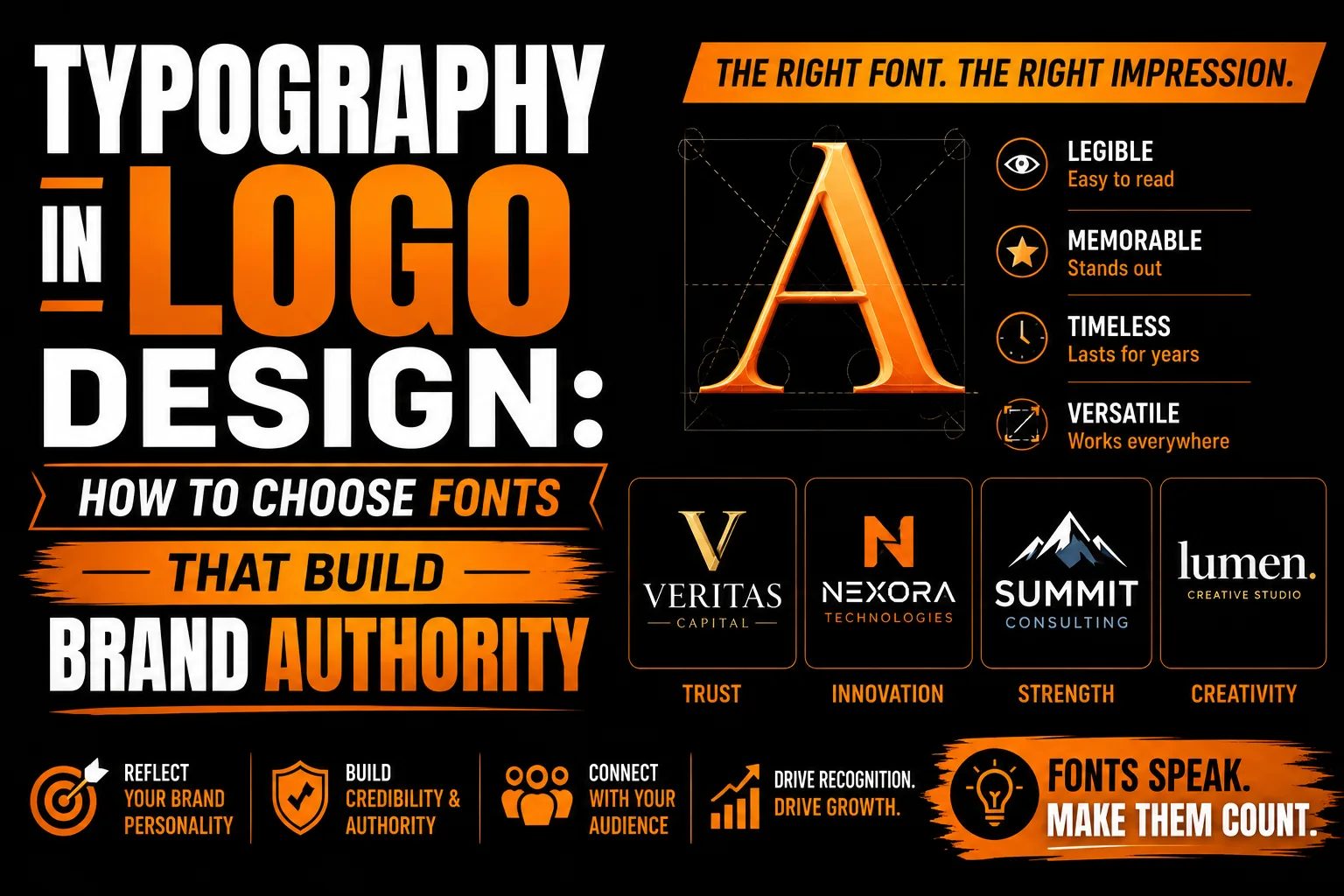
Typography in Logo Design: How to Choose Fonts That Build Brand Authority
Typography is the most underappreciated element of logo design. Most clients focus their attention on the mark, the icon, symbol, or graphic element, while the typographic treatment of the brand name does the majority of the emotional and positioning work in wordmark and combination mark logos. A well-chosen typeface in perfect proportion communicates the brand’s personality, industry positioning, and target audience without a single graphic element. A poorly chosen typeface undermines every other design decision in the logo, including an otherwise excellent mark. This guide covers everything needed to make typographic decisions that build rather than undermine brand authority.
Key takeaways
- Give the typeface of the brand name as much attention as the icon, since it does most of the positioning work.
- Match the serif style to your positioning, such as old-style for warmth with authority or slab serif for strength.
- Adjust letter-spacing intentionally, since default tracking is calibrated for body text rather than for logo scale.
How Typography Communicates Before It Is Read
Typography communicates on two levels simultaneously: the literal level (the words it spells) and the visual level (the impression the letterforms themselves create before the words are consciously processed). At the visual level, the shapes of letters, the thickness of strokes, the presence or absence of serifs, the proportions of capitals to lowercase, and the spacing between letters all create an emotional impression that reaches the viewer before conscious reading begins.
This pre-reading impression is what designers mean when they describe a font as “feeling” authoritative, playful, modern, or traditional. The feeling is not arbitrary, it is the result of consistent associations between specific typographic characteristics and specific contexts where those characteristics have been historically used. Serif fonts feel authoritative partly because they were used in authoritative contexts, legal documents, financial publications, academic texts, for centuries before contemporary branding existed. Sans-serif fonts feel modern partly because their widespread adoption in modernist design movements of the 20th century created an association between those letterforms and the values of that movement: clarity, efficiency, rationality, and progress.
The Five Major Typeface Categories and Their Brand Associations
Serif typefaces divide into several subcategories, each with distinct associations. Old-style serifs, Garamond, Caslon, Palatino, have organic, calligraphic roots that communicate warmth alongside authority. They work well for brands in law, finance, publishing, education, and luxury goods where heritage and depth are valued. Transitional serifs, Times New Roman, Baskerville, Georgia, are more geometrically precise and communicate formal authority and institutional credibility. Modern serifs, Bodoni, Didot, have dramatic contrast between thick and thin strokes that communicates high fashion and luxury. Slab serifs, Rockwell, Clarendon, Memphis, have heavy, square-ended serifs that communicate strength, confidence, and directness, working well for technology companies, sporting brands, and businesses that want to signal reliability rather than refinement.
Geometric sans-serif typefaces, Futura, Avenir, Montserrat, Gotham, are built on precise geometric shapes and communicate modernity, precision, and forward-thinking values. They are the dominant font category in technology, architecture, and contemporary professional services branding. Humanist sans-serif typefaces, Gill Sans, Myriad, Frutiger, Calibri, have organic proportions derived from calligraphic roots, making them simultaneously modern and warm. They communicate accessibility alongside professionalism, working particularly well for healthcare, education, and consumer-facing professional services.
Script and handwritten typefaces range from formal calligraphic scripts that communicate elegance and craftsmanship to casual handwritten fonts that communicate authenticity and approachability. They are appropriate only in specific contexts where the handmade or personal quality is central to the brand proposition, artisan food producers, wedding industry brands, personal care products, boutique hospitality. In most professional service contexts, script fonts undermine rather than support the authority positioning the brand needs.
The Critical Role of Weight and Proportion
The weight of a typeface, from ultra-light to ultra-black, communicates as powerfully as the typeface category itself. Heavy, bold weight communicates confidence, strength, and accessibility, it demands attention and holds it. Light, thin weight communicates refinement, sophistication, and premium positioning, it invites attention rather than demanding it. Medium weight balances these qualities and is the most versatile choice for brands that need to communicate across a wide range of applications and audiences.
In logo typography, the weight must be tested at every scale the logo will appear. A light-weight font that looks refined at large scale on a website header may become illegible as a favicon or embroidered on a cap. A bold typeface that reads powerfully on a business card may feel overwhelming at billboard scale. The weight decision must be made with all applications in mind, not just the primary viewing context.
Letter-Spacing: The Professional Designer’s Most Used Tool
Of all the typographic adjustments available to a logo designer, letter-spacing (tracking) has the largest impact on perceived quality and brand positioning. Default letter-spacing in most typefaces is calibrated for body text legibility, the spacing that makes paragraphs comfortable to read. Logo typography operates at different scales and different reading distances, and almost always benefits from intentional letter-spacing adjustment.
Wide letter-spacing, setting the characters with significant air between them, immediately elevates the perceived quality of a wordmark and communicates premium positioning. It is not a coincidence that the logos of luxury fashion brands, high-end hospitality groups, and premium product brands almost universally use wide letter-spacing. The visual effect signals deliberateness and refinement, qualities that directly support premium pricing.
Tight letter-spacing, bringing characters closer together than the default, creates density and urgency. It is effective for brands that want to communicate efficiency, speed, and directness. Technology companies, financial technology brands, and logistics companies often use tight letter-spacing to signal that they value their clients’ time and are oriented toward rapid results.
Custom Lettering: When Typefaces Are Not Enough
The most distinctive wordmark logos in the world are not set in standard typefaces, they are built on custom lettering where individual characters have been drawn specifically for the brand. Custom lettering creates a wordmark that cannot be replicated by setting text in any available font, which provides a level of visual distinctiveness that standard typeface usage cannot achieve and supports stronger trademark protection.
Custom lettering is not necessary for most logos, but it is the appropriate choice for brands where the wordmark is the primary brand element, where there is no separate icon or mark, and where visual distinctiveness at the typographic level is essential to the brand’s competitive positioning. At the appropriate budget level, custom lettering is a worthwhile investment that creates a mark that is truly unique.
Frequently Asked Questions About Typography in Logo Design
What is the difference between serif and sans-serif fonts in logo design?
Serif fonts have decorative strokes at the ends of letterforms and communicate tradition, authority, credibility, and established expertise. They perform well for professional services, legal firms, financial institutions, and luxury brands. Sans-serif fonts have no decorative strokes and communicate modernity, clarity, accessibility, and efficiency. They perform well for technology companies, startups, and consumer brands positioning around contemporary relevance.
Can I use a free font for my business logo?
You can use a free font with important caveats. Free fonts from reputable sources like Google Fonts are licensed for commercial use and are legitimate choices. However, free fonts are available to every other business, reducing your logo’s distinctiveness. For a logo intended to be trademarked, confirm the font license explicitly permits use in a registered trademark before proceeding.
What is letter-spacing and how does it affect a logo?
Letter-spacing (tracking) is the uniform adjustment of space between all characters. Wide letter-spacing communicates luxury, refinement, and deliberate quality, used extensively by fashion brands and premium product brands. Tight letter-spacing communicates density, urgency, and efficiency, effective for technology and financial technology brands. Professional logo designers almost always adjust letter-spacing beyond the default to improve visual weight and brand communication.
Should I use more than one font in my logo?
Using two fonts, a primary for the business name and a secondary for a descriptor or tagline, is common and effective when fonts are chosen to complement rather than compete. The key principle is contrast: pair a serif with a sans-serif, or a bold display font with a lighter weight. Never use more than two fonts in a single logo, three or more create visual complexity that signals lack of design discipline.
What fonts are overused in logo design and should be avoided?
Papyrus is associated with low-budget design. Comic Sans is universally recognized as unprofessional. Trajan has been overused in legal and cinematic contexts. Copperplate Gothic appears on so many professional service logos it has lost its authority signal. The goal is not to avoid these because they are bad typefaces, but because their overuse prevents them from contributing any distinctive signal to a brand identity.