
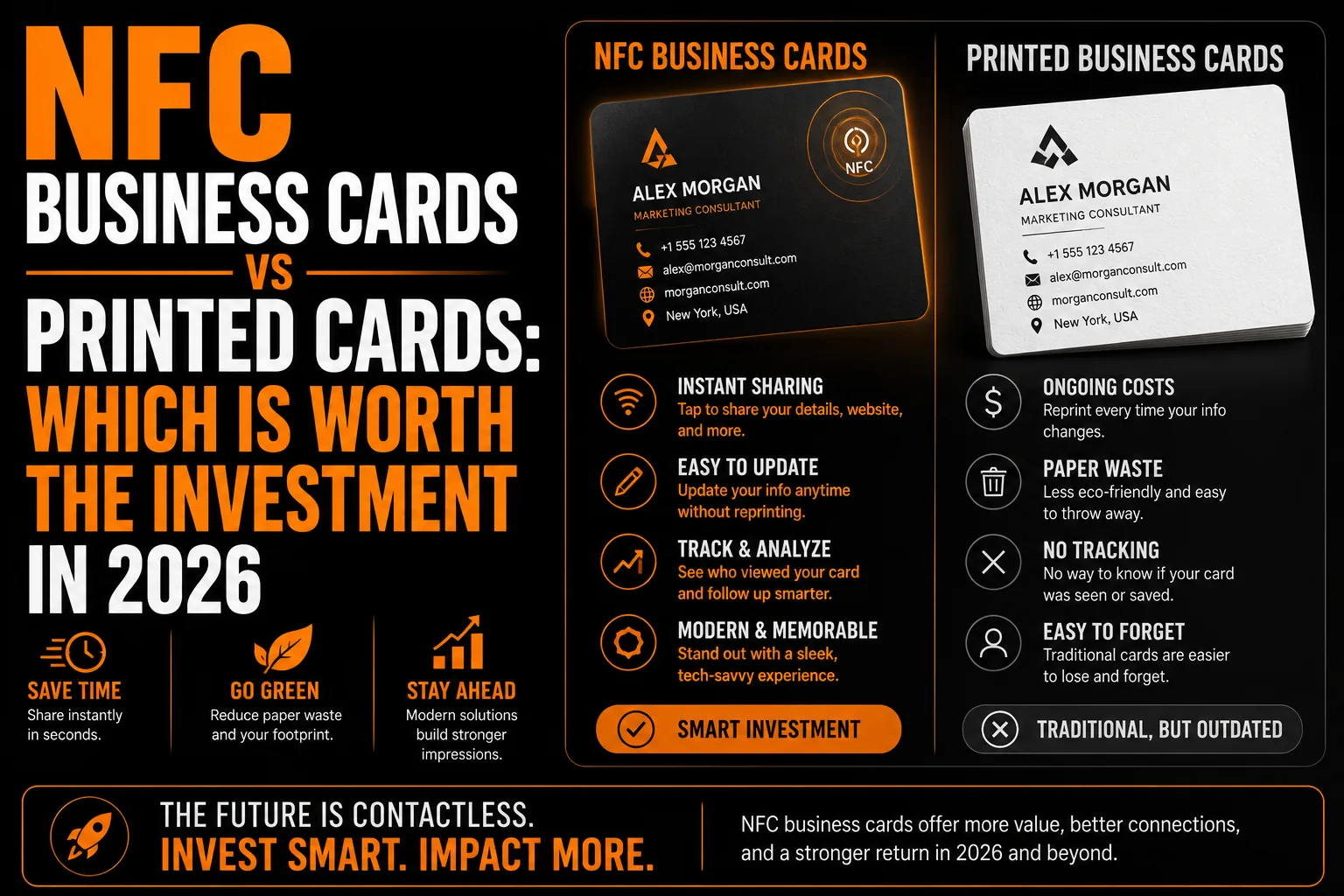
NFC Business Cards vs Printed Cards: How to Choose
NFC business cards have moved from novelty to mainstream in the last three years. They are now offered by dozens of platforms, used by millions of professionals, and have become a standard topic in every conversation about professional networking tools. The marketing from NFC card companies consistently positions them as the obvious replacement for printed business cards. The reality is more nuanced, and understanding the genuine strengths and genuine limitations of each format helps professionals make the right choice for their specific networking context rather than following a trend that may or may not serve their objectives.
What NFC Cards Actually Do Well
NFC technology in a business card context solves three genuine problems that printed cards cannot address. The first is information capacity. A printed card has space for perhaps 80 to 100 words of text and two or three visual elements. An NFC card can link to a digital profile containing a complete portfolio, a video introduction, all social media profiles, a direct scheduling link, multiple contact methods, and any other digital content the professional wants to share. For roles where showing work is essential to the business development conversation, designers, photographers, architects, consultants, the ability to share this content with a single tap is genuinely more effective than handing over a card and hoping the recipient visits the website later.
The second problem NFC solves is update friction. A printed card becomes outdated every time a phone number changes, a job title changes, or a company is rebranded. Reprinting costs money and creates a gap where outdated cards remain in circulation. An NFC card’s digital destination can be updated instantly, the physical card remains the same, but the information it delivers changes in real time. For businesses with frequent staff turnover, rapid growth, or active rebranding, this flexibility has real value.
The third advantage is analytics. NFC platforms provide data on how many times a card was tapped, when, and what actions the recipient took on the digital profile, did they save the contact, visit the website, click the scheduling link? This is information that printed cards cannot provide and that allows professionals to measure the actual performance of their networking activity rather than simply trusting that cards handed out are producing follow-up actions.
Where Printed Cards Still Win
Despite the genuine capabilities of NFC technology, printed business cards retain meaningful advantages in specific contexts that are not declining in relevance. The most significant is the tactile impression. A well-designed printed business card, on 400gsm stock with soft-touch laminate and a foil-stamped logo, creates a physical brand impression that no NFC card currently matches. The card is heavy, unusual in texture, and beautiful in a way that makes the recipient examine it more closely and remember it longer. This sensory effect is not replicated by a plain plastic or metal NFC card, regardless of what digital content it links to.
In high-stakes professional interactions, senior client meetings, partner introductions, investor conversations, the quality signal of a premium printed card communicates something about the professional’s standards and attention to detail that NFC cards do not yet convey. The physical artifact has value in trust-based professional relationships that the digital link cannot replace.
International contexts present a specific challenge for NFC cards. NFC adoption and comfort varies significantly across markets. In Japan, South Korea, and many parts of Europe, printed business card exchange is a practiced ritual with specific etiquette that NFC tapping does not replicate. Attempting to substitute an NFC card for a printed card in contexts where the printed card exchange has cultural significance risks creating awkwardness that undermines the networking objective.
Finally, printed cards do not require a subscription. An NFC card platform that loses your subscription may redirect your tap destination to a default page or service error. A printed card continues to work regardless of what happens to any vendor’s platform or pricing structure.
The Honest Cost Comparison
NFC card advocates often present the comparison as: a one-time purchase of an NFC card versus the ongoing cost of reprinting paper cards. This comparison is accurate but incomplete. A premium NFC card costs $20 to $150 for the physical card. The platform subscription costs $5 to $15 per month, $60 to $180 per year, to maintain the digital profile. Over three years, the total cost is $200 to $690.
250 premium printed business cards with soft-touch laminate and foil stamping cost $150 to $400 for a print run that lasts most professionals one to three years depending on networking volume. 250 standard professional cards cost $30 to $80. Over three years, the total printed card cost for an active networker is $90 to $400, lower than or comparable to NFC, depending on card quality and networking volume.
The comparison is not a clear financial win for either format. The right decision is based on use case and networking context, not on cost alone.
The Optimal Strategy: Use Both for Different Purposes
The professionals who get the most from both formats use them simultaneously for different purposes. A small supply of premium printed cards, 50 to 100 cards ordered at a time, serves the high-value, high-trust interactions where physical quality matters: senior client meetings, important referral introductions, and any context where the card will be examined closely and kept. An NFC card serves high-volume networking contexts, industry conferences, trade shows, casual networking events, where convenience and digital content sharing add value and where the physical card is more likely to be lost in a stack than appreciated individually.
Frequently Asked Questions About NFC vs Printed Business Cards
What is an NFC business card and how does it work?
An NFC business card contains an embedded chip that transmits data to a compatible smartphone when devices are brought close together. When someone taps their phone against your NFC card, their phone automatically opens a webpage, contact card, or other digital destination you have configured. No app download is required for the recipient. The digital destination can be updated at any time without replacing the physical card.
What are the main advantages of NFC business cards over printed cards?
NFC cards offer three significant advantages: the digital destination can be updated at any time without reprinting, they can link to far more information than a printed card can contain, and they generate usage analytics, you can see how many times the card was tapped and what actions the recipient took, providing data that printed cards cannot.
What are the disadvantages of NFC business cards?
NFC cards require the recipient to have a compatible NFC-enabled smartphone. The physical card typically cannot create the tactile premium impression that a well-designed printed card with specialty finishes achieves. And they require an ongoing platform subscription, typically $5 to $15 per month, to maintain the digital profile. If the subscription lapses, the tap destination may no longer work.
Who should use NFC business cards versus printed cards?
NFC cards are most valuable for professionals who network frequently in tech-forward environments, professionals who need to share large amounts of digital content, and businesses where updating contact information without reprinting is genuinely valuable. Printed premium cards remain superior in luxury, finance, law, and high-trust contexts where the physical quality signal is integral to the brand impression.
Can I use both NFC and printed business cards?
Yes, using both strategically maximizes the benefits of each format. Carry premium printed cards for high-value one-on-one interactions where physical quality matters. Use an NFC card as your primary networking tool at conferences and events where convenience and digital link capability add the most value. The two formats serve different purposes and are not mutually exclusive. For a related practical example, see our guide to recovering a logo from an old printed business card.