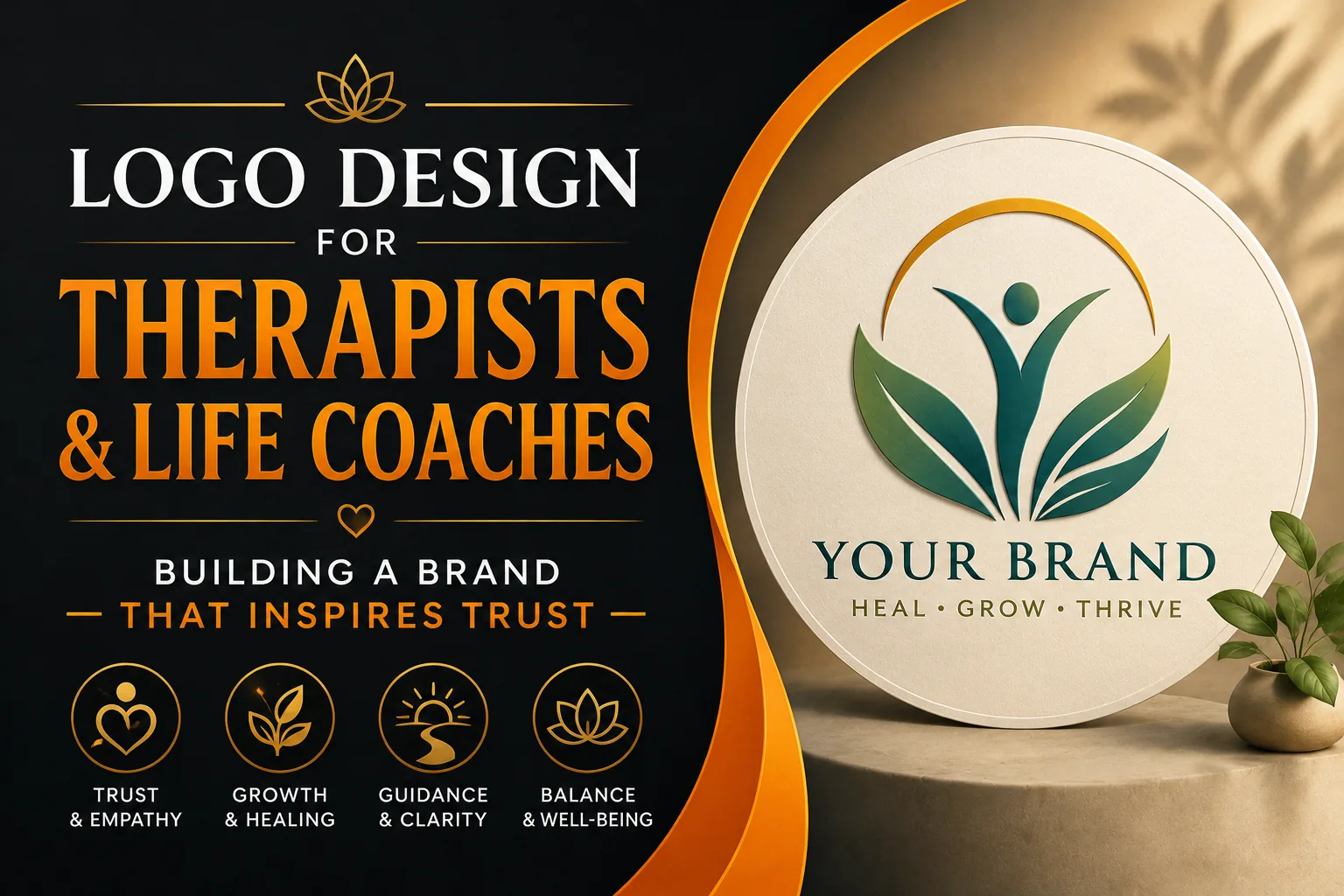
Logo Design for Therapists and Life Coaches: Building a Brand That Inspires Trust
In the wellness and mental health space, a logo does something that logos in most other industries do not need to do: it signals safety. Before a potential client reaches out to book a session, they have spent time on your website, reviewed your credentials, and formed an impression of whether you feel like a safe, competent, and trustworthy professional. Your logo is part of that first impression, and it either contributes to the feeling of safety or creates friction. This guide covers everything wellness professionals need to know about designing a logo that works for their specific context.
Key takeaways
- Avoid aggressive colors, sharp angular forms and chaotic compositions that clash with the calm and trust clients seek.
- Consider refined serif or clean humanist sans-serif fonts, the two most effective typography routes for wellness practices.
- Prepare square or compact logo versions that stay legible at small sizes on online directory profiles.
Understanding What Your Logo Must Communicate
A therapy or coaching logo must communicate a specific cluster of qualities: calm, trust, competence, warmth, and approachability. These are non-negotiable in a category where clients are often in a vulnerable state when they first make contact. Any design element that conflicts with these qualities, aggressive colors, sharp angular forms, overly complex or chaotic compositions, creates a subconscious disconnect that may prevent a potential client from reaching out.
Secondary to the baseline trust signals, your logo should communicate your specific approach and niche. A somatic therapist working with trauma has different aesthetic needs than a business coach working with executives. A grief counselor serving older adults needs a different visual register than a millennial-focused anxiety therapist who markets primarily through Instagram. Defining your specific positioning before any design work begins ensures the final result speaks directly to the people you most want to reach.
Color Strategy for Wellness Professionals
Color is the most immediately processed design element and the one that most powerfully communicates emotional tone. In the wellness space, color choices carry particular weight because they contribute directly to the perceived emotional environment of your practice.
Soft teal and sage green are among the most effective colors for therapy and coaching brands. Teal combines the trustworthiness of blue with the growth associations of green. Sage green communicates nature, balance, and calm without the clinical associations of hospital green. These colors work particularly well for wellness practitioners who emphasize a holistic, whole-person approach.
Warm navy blue remains the strongest trust signal available in any color palette. It communicates stability, expertise, and reliability across virtually all demographics and cultures. Navy-based logos perform particularly well for therapists working with anxiety disorders, where the client’s primary need is reassurance that they are in safe, competent hands.
Muted lavender and dusty purple communicate creativity, intuition, and introspection. These work well for therapists and coaches who emphasize creative modalities, spiritual dimensions of wellbeing, or work with particularly creative or artistic client populations.
Warm earth tones, terracotta, warm beige, clay, and rust, are growing in the wellness space and communicate grounding, naturalness, and approachability. They work especially well for somatic practitioners, nature-based therapies, and coaches who emphasize embodiment and presence over cognitive approaches.
Typography That Feels Safe and Professional
Font choice in a therapy or coaching logo communicates personality and approach as clearly as color does. The two most effective typography approaches for wellness professionals are refined serif fonts and clean humanist sans-serif fonts, each communicating different but equally valid qualities.
Refined serif fonts, particularly those in the transitional or humanist serif category, communicate experience, depth, and scholarly credibility. They suggest a practitioner who is well-trained, thoughtful, and serious about their craft. These work well for therapists with doctoral credentials, long-established practices, or a more traditional clinical approach.
Clean humanist sans-serif fonts communicate warmth, accessibility, and modernity without sacrificing professionalism. Fonts like Lato, Nunito, and similar humanist designs feel approachable and contemporary. They work particularly well for coaches, younger therapists building a digital-first practice, and practitioners who want to signal that their approach is accessible rather than clinical.
Avoid heavily stylized script fonts, aggressive display typefaces, and novelty fonts. While they may feel distinctive, they undermine the professional credibility signals that are foundational to client acquisition in the wellness space.
Symbols and Icons: What Works and What to Avoid
The most effective logo icons for therapy and coaching practices fall into four categories. Abstract circular forms, complete circles, partial circles, and flowing arc shapes, suggest wholeness, continuity, and the cyclical nature of growth. They are the most universally appropriate symbol type for this category. Botanical elements like leaves, branches, and abstract plant forms suggest organic growth, nature, and gentle forward movement. They are particularly effective for practices emphasizing holistic wellness. Abstract human forms suggesting connection, support, or forward movement communicate the relational and directional aspects of therapeutic work without being overly literal. Flowing line forms suggest calm, movement, and the flowing quality of emotional processing.
Several symbols should be actively avoided because they have become clichés in the wellness space that no longer communicate anything distinctive: the infinity symbol, the stylized brain illustration, the puzzle piece, the butterfly, and the lotus flower have all been used so extensively that they blend into the visual background of the category rather than creating differentiation.
Applying Your Logo Across a Therapy Practice
A therapy or coaching logo needs to work across a specific set of applications that are different from most other professional service logos. Your website header is the primary application where the logo establishes the tone for the entire client experience. Psychology Today, Headway, and similar directory profiles require square or compact logo versions that remain legible at small sizes. Business cards and letterhead carry the logo in client correspondence. Intake forms and clinical documents may require a simple black-and-white version. Social media profiles, particularly Instagram and LinkedIn, need a compact, recognizable version at small sizes.
Test your logo in all of these contexts before finalizing any design. A logo that looks beautiful at large size on a website header but becomes illegible as a Psychology Today profile picture has failed a critical real-world test.
Frequently Asked Questions About Therapy and Coaching Logo Design
What colors work best for a therapy or coaching logo?
The most effective colors are soft teal and sage green for calm and growth, warm navy blue for trust and stability, muted lavender for creativity and introspection, and warm earth tones like terracotta for grounding and approachability. Avoid bright red, aggressive orange, and neon colors, which conflict with the calm environment clients expect from wellness professionals.
Should a therapist logo include the person’s face or photo?
A therapy or coach logo should generally not include a photo or realistic facial illustration. Photos become dated quickly and create production problems across different applications. A well-designed abstract mark, botanical element, or clean typographic wordmark is more versatile, more timeless, and more professionally appropriate.
What symbols are appropriate for a therapy or coaching logo?
Effective symbols include abstract circular forms suggesting wholeness, subtle botanical elements suggesting growth, gentle wave or flowing line forms suggesting calm, and abstract human forms suggesting connection. Avoid overused symbols like the infinity sign, brain illustration, and puzzle piece, which have become clichés that do not differentiate your practice.
How important is a professional logo for a therapist in private practice?
A professional logo is critically important for therapists accepting self-pay clients. Clients making a significant financial and personal commitment evaluate the professionalism of the practice before booking. A polished, cohesive visual identity communicates that the therapist is established and serious about their work, reducing hesitation at first contact.
Should a therapy logo include a tagline?
A tagline is optional but effective when it communicates a specific niche that differentiates the practice. Keep any tagline under six words and ensure the logo works equally well with and without the tagline, since it will often be removed in small-scale applications like social media profile pictures.