Logo Shapes and Geometry: What Circles, Triangles, and Squares Communicate About Your Brand
Logo shapes can suggest different qualities, but their meaning depends on the complete design, audience and context. A circle is not a universal promise of trust, and an angle is not automatically aggressive. Compare shape options alongside typography, colour and real applications, then ask whether customers recognize the business you want to present.
Key takeaways
- Compare shape options within complete logo designs, since a shape’s meaning depends on typography, colour and context.
- Do not treat a circle as a universal promise of trust or an angled form as automatically aggressive.
- Test several triangle orientations with your business name to check the reference is clear and not a common symbol.
The silhouette of a logo supports recognition, but geometry never works in isolation. Typography, colour, spacing, composition and the audience’s context all influence how a circle, triangle or irregular form is understood. A small business should therefore compare shapes within complete logo options and on real applications. The practical goal is to find a distinctive structure that supports the intended message without relying on a fixed dictionary of visual meanings. This distinction also gives the business a clear starting point for applying the following guidance to its actual file, channel and intended result.
How Shape and Context Influence Perception
People can associate sharp, rounded or regular forms with different qualities, but those associations are not universal rules. A sharp form might suggest precision in one composition and discomfort in another; a rounded shape can feel approachable or simply ordinary. Avoid treating such interpretations as fixed biological responses shared by every audience. Compare the complete mark, its surrounding message and its use in the business’s category before deciding what a particular shape communicates.
Familiar references also influence interpretation. A triangle might resemble a mountain, an arrow or a play button depending on its orientation and surrounding elements. The same outline can therefore suggest different things in different contexts. In a logo project, list the associations you want to encourage and those you want to avoid, then compare alternatives with the business name and typography. Feedback from intended customers is more useful than assuming a geometric dictionary will predict their response in advance.
Circles: Unity, Continuity, and Completeness
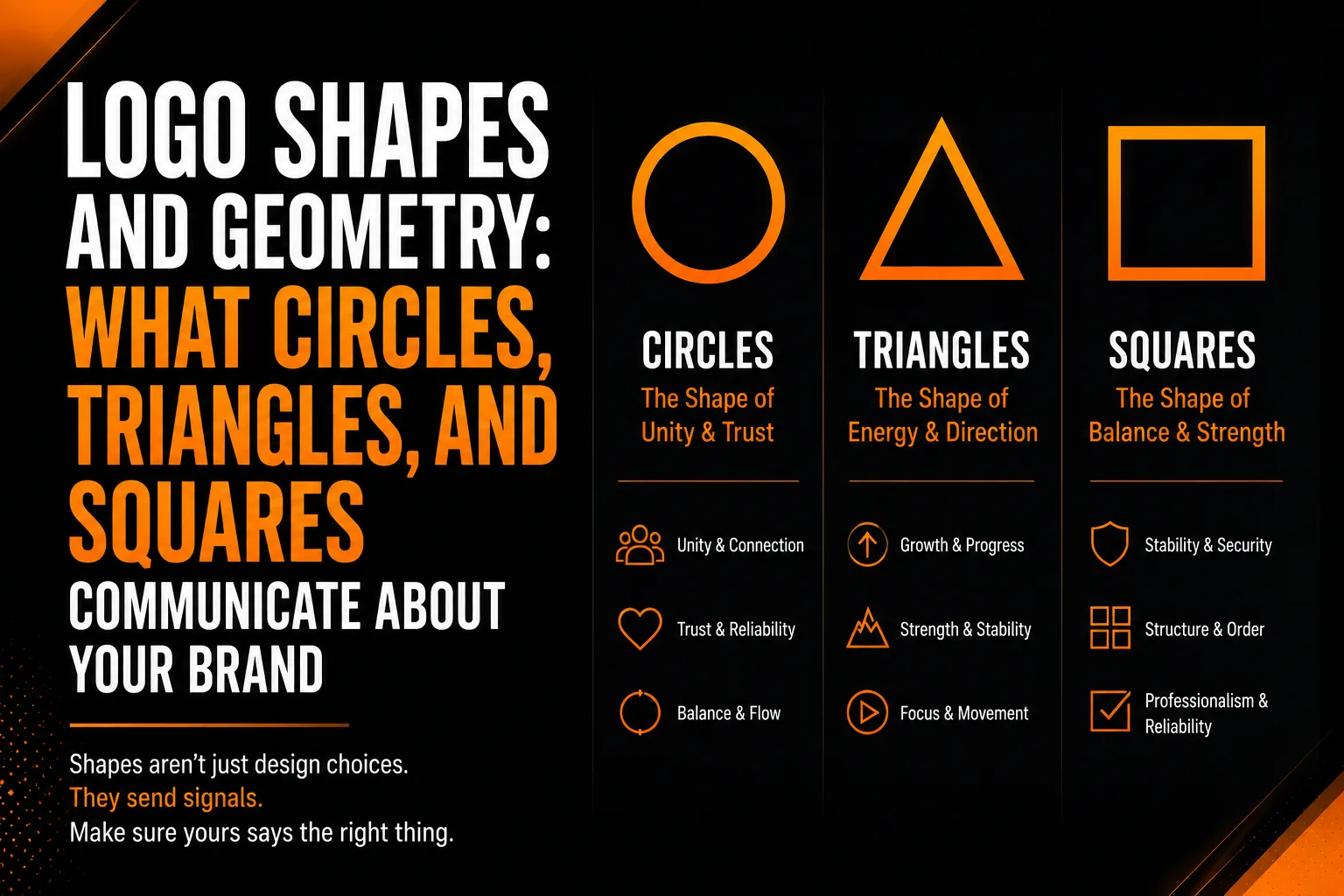
A circle offers a continuous outline and a compact area for organizing a symbol or name. Designers may use it to suggest unity, continuity or a sense of enclosure, but the impression depends on the whole composition. A thin open circle and a heavy closed badge do not have the same character. Compare stroke weight, spacing and the relationship between the outer shape and its contents. These decisions can make the mark feel more restrained, expressive or familiar without relying on a universal promise of trust.
For a small business, a circular composition can be practical on profile images, stickers or compact labels. It can group a short name with a symbol and create a recognizable silhouette across those uses. Start with the actual content, however: a long business name may become too small when forced around a tight circle. Test a compact badge alongside a horizontal version and see which works in each space. The circle is one option for organizing the identity, not a default requirement for a trustworthy business.
A circle can also become generic or crowded if the composition relies only on its outline. Direction and energy can still be introduced through internal shapes, open edges or type. Judge the final balance rather than excluding circles whenever the brand needs to feel dynamic.
Triangles: Direction, Progress, and Dynamic Energy
A triangle introduces directional cues through its points, orientation and proportions. It may suggest a peak, movement or a familiar interface symbol, depending on the context. An upward form can feel stable when its base is broad, while an angled or narrow form may feel more active. These are design possibilities rather than guaranteed meanings. Compare several orientations with the business name and intended supports to see whether the reference is clear, distracting or easily confused with a common symbol.
Triangular elements can suit a business that wants a precise or energetic visual direction, but the drawing determines much of the result. Rounded corners, a softer typeface or a wider base can change how the same basic geometry feels. An angular mark is not automatically unsuitable for a welcoming business, just as it does not automatically communicate technical expertise. Check the silhouette at small sizes and in one color, then ask whether the complete identity expresses the character the business wants customers to recognize.
Squares and Rectangles: Stability, Order, and Reliability
Squares and rectangles can provide a clear structure for a logo because their edges create an obvious frame and alignment system. Designers may use that regularity to suggest order, precision or stability. Those associations depend on context; right angles are not an exclusively human-made feature, and a box does not guarantee a professional impression. For a business identity, consider how the symbol, name and spacing work within or around the frame. The practical layout can be as important as the shape’s suggested character.
A rectangular composition can feel static if all its elements are equally heavy and rigidly aligned, but that is not an unavoidable property of the shape. Rotation, varied spacing, an open edge or an internal directional element can change the balance. Test whether such changes improve recognition and readability rather than adding movement only for decoration.
Organic and Irregular Forms: Authenticity, Naturalness, and Human Warmth
Organic forms use irregular curves, flowing lines or references to natural objects. They can support a handmade, personal or nature-inspired direction when the rest of the identity reinforces it. For an artisan business, for example, a distinctive irregular outline may echo the character of its work. That does not make every organic shape authentic or every geometric mark impersonal. Compare the shape with the business’s actual offer and language so the visual impression is grounded in something customers can recognize.
The technical challenge depends on detail rather than the organic label alone. A simple irregular silhouette may reproduce easily, while a complex geometric pattern may not. Check fine gaps, line weights and the smallest application. Prepare a simplified variant when needed for embroidery or one-color reproduction, preserving the features that make the mark recognizable across those supports.
Frequently Asked Questions About Logo Shape and Geometry
Why do so many logos use circular shapes?
Circles provide a compact outline and can suggest continuity, enclosure or a shared space. They also fit some profile and label formats conveniently. The impression depends on the interior design, line weight and typography, however. A circle is not automatically reassuring to every audience or suitable for every name; test the full mark in its intended applications.
What does a triangle communicate in a logo?
A triangle can suggest direction, a peak or movement, depending on orientation and context. Its proportions and corners influence whether it feels stable, sharp or expressive. Compare it with the type and business name rather than assuming an upward point always means growth or a right-facing point always means speed.
What brand values do square and rectangular shapes communicate?
Their regular outlines can support an impression of order or stability, particularly when the typography and spacing reinforce it. The effect is contextual, not guaranteed. A rectangular frame also creates practical questions: does the name fit comfortably, does the border remain visible when small, and does the composition work in the required spaces?
What is the difference between geometric and organic shapes in logo design?
Geometric shapes use regular structures such as circles or polygons; organic forms tend toward irregular curves or natural references. Either can express several different qualities. Choose according to the complete composition and the business’s intended character, then verify readability and reproduction rather than treating one family of shapes as inherently more authentic.
Can a logo use more than one geometric shape effectively?
Yes, when the combination remains clear and recognizable. A circle and triangle might suggest an enclosed direction to one audience, but another may read a familiar interface symbol. Test the silhouette and the intended association. Each added element should help identify the business or organize the mark rather than merely making the geometry more complex.