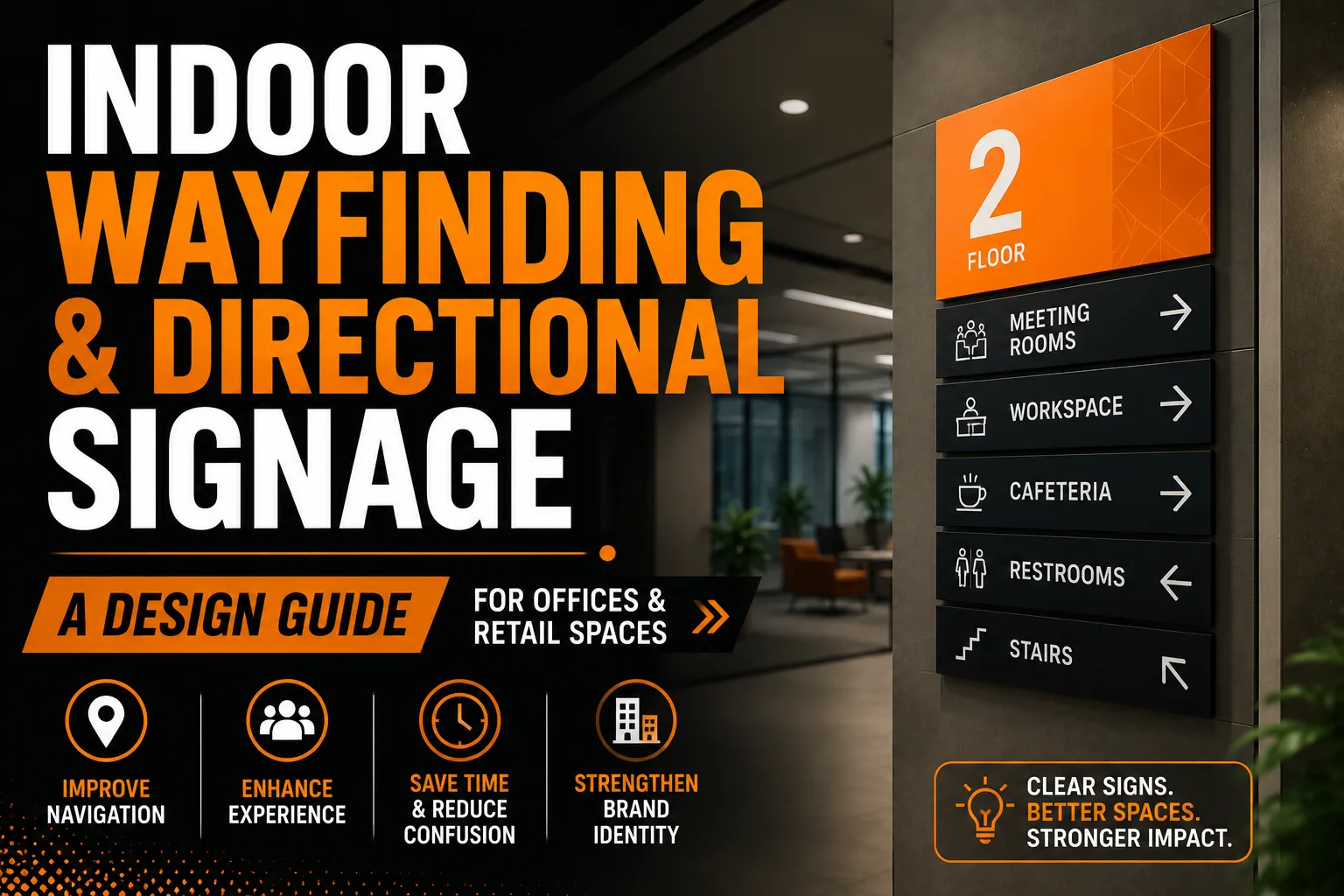
Indoor Wayfinding and Directional Signage: A Design Guide for Offices and Retail Spaces
Every business with a physical space that receives visitors has a wayfinding challenge. Whether it is an office building where clients arrive for meetings, a medical clinic where patients navigate between reception and treatment areas, a retail store where customers look for specific product categories, or a hotel where guests find their rooms and amenities, the quality of the wayfinding system directly affects the visitor’s experience of the brand before any service interaction has occurred. A visitor who enters your space confident and oriented is in a better emotional state for the interaction that follows. A visitor who has spent five minutes looking for the reception desk is not.
Key takeaways
- Start with a space audit that walks every visitor path and notes each point where people could become uncertain.
- Use brand colors as accents on arrows, frames or room number fields rather than as full backgrounds that hurt legibility.
- Design one consistent visual template that spans all four sign types of your indoor wayfinding system.
The Business Case for Professional Wayfinding Design
Poor wayfinding is most commonly experienced as a minor inconvenience by visitors, but its costs to the business are real and measurable. Reception staff in offices with inadequate directional signage spend a significant portion of their time giving verbal directions to visitors, time that could be spent on more valuable tasks. In medical and healthcare facilities, wayfinding failures contribute to patient stress, appointment tardiness, and dissatisfaction scores. In retail, customers who cannot find what they are looking for in a reasonable time abandon the search and the purchase.
The perception cost is harder to quantify but equally real. A visitor’s navigation experience is their first physical interaction with your brand after arrival. Arriving in a beautiful reception area with a professional logo display, then being unable to find the meeting room without help, creates a dissonance between the quality signal of the visual identity and the frustration signal of the navigation failure. The visitor resolves this dissonance by downgrading their overall impression of organizational competence, regardless of how excellent the subsequent meeting may be.
The Four Sign Types Every Wayfinding System Needs
A complete indoor wayfinding system consists of four functionally distinct sign categories, each serving a specific navigation purpose. Understanding these categories and designing a consistent visual template that spans all four is the foundation of an effective wayfinding system.
Identification signs name destinations, conference room names, department labels, suite numbers, office names. They answer the question “Is this the right place?” when a visitor arrives at a destination. Identification signs are the most stationary and permanent of the four types and are typically mounted at or slightly above eye level at the entrance to each space. For temporary needs such as an event in your lobby, a retractable stand fills the gap, and designing a readable roll-up banner follows the same legibility logic.
Directional signs guide movement through the space, corridor arrows pointing toward destinations, overhead suspension signs at decision points where the visitor must choose a direction. They answer the question “Which way do I go?” Directional signs must be positioned at every point where a visitor could reasonably become uncertain, intersections, elevator lobbies, floor transitions, and any point where a long corridor branches.
Informational signs provide supplementary context, operating hours, access rules, capacity limits, facility maps. They answer the question “What do I need to know about this space?” Informational signs supplement the navigation system rather than driving it and can afford more text density than directional signs because viewers approach them deliberately to read them.
Regulatory signs communicate legal requirements, fire exit locations, ADA accessibility symbols, occupancy limits, no-smoking zones. They are defined by regulatory standards that specify required symbols, colors, and in some cases text, leaving less design discretion than other sign types but still allowing visual consistency with the broader system through consistent framing, material, and mounting approach.
Integrating Brand Identity Without Compromising Legibility
The most common error in branded office signage is applying brand colors as full-bleed backgrounds on directional signs in a way that reduces legibility. A dark navy background with white text may look appropriately on-brand in a bright, well-lit reception area but becomes difficult to read in a poorly lit service corridor or a space where the lighting changes seasonally. A more reliable approach uses brand colors as accent elements, colored arrow backgrounds, colored sign frames, colored room number fields on otherwise neutral sign bodies, while maintaining high-contrast text combinations across all lighting conditions.
Typography in a wayfinding system must prioritize legibility over brand alignment when the two conflict. If your brand typography is a decorative serif font that performs beautifully in large-format marketing but becomes illegible at small sizes in low light, the wayfinding system should use your secondary typeface or a high-legibility wayfinding-specific alternative. The brand should be present and recognizable without compromising the functional quality of the navigation experience.
Planning and Sequencing a Wayfinding Design Project
A professional wayfinding project begins with a space audit, walking every visitor path from every entry point to every destination, noting every decision point where a visitor could become uncertain, and documenting the existing visual environment (wall colors, lighting quality, door frame styles, ceiling heights) that will define the physical context for each sign. The audit produces a site map with every required sign location, type, and approximate size before any design work begins.
The design phase develops the visual template, the design system that defines how each sign type looks, followed by specific designs for each identified sign location. A physical prototype of the most complex sign type should be reviewed in the actual installation environment before the full production run, as colors and finishes read differently in their installed location than they do on screen or in a print proof.
Frequently Asked Questions About Indoor Wayfinding Signage
What is wayfinding design and why does it matter for businesses?
Wayfinding design is the systematic use of signage and visual cues to help people navigate a space confidently and independently. It matters because a visitor who cannot find what they are looking for becomes frustrated, and that frustration is associated with your brand. Effective wayfinding reduces reception staff time spent giving directions, improves the visitor experience before any service interaction begins, and reinforces brand professionalism throughout the space.
What types of signs does a complete indoor wayfinding system include?
A complete system includes four categories: identification signs (naming spaces), directional signs (guiding movement with arrows), informational signs (providing contextual details), and regulatory signs (communicating legal requirements). A professional system uses a consistent visual template across all four categories to create a coherent experience rather than a collection of unrelated signs.
How should a company’s brand identity be integrated into an office signage system?
The most effective approach uses brand colors as accent elements, colored directional arrows, colored sign frames, colored room number fields, rather than as full-bleed backgrounds that can reduce legibility in low-light conditions. The company logo typically appears on the reception area sign and key directional decision-point signs, not on every individual room label.
What font size should be used for indoor directional signs?
For signs read from 2 to 5 meters, primary text should be a minimum of 25mm to 35mm in cap height. For signs read from 5 to 10 meters, primary text should be a minimum of 40mm to 50mm. Using a clean, high-legibility sans-serif typeface is essential for wayfinding applications regardless of the brand’s primary typography.
What materials work best for indoor office signage?
Brushed aluminum or stainless steel works best for reception and executive level signs. Acrylic in various finishes is versatile and cost-effective for general directional and room identification signs. High-pressure laminate (HPL) suits high-traffic areas. The material choice should be consistent across a signage family, mixing metallic and plastic signs in the same corridor undermines the professional impression of the space.