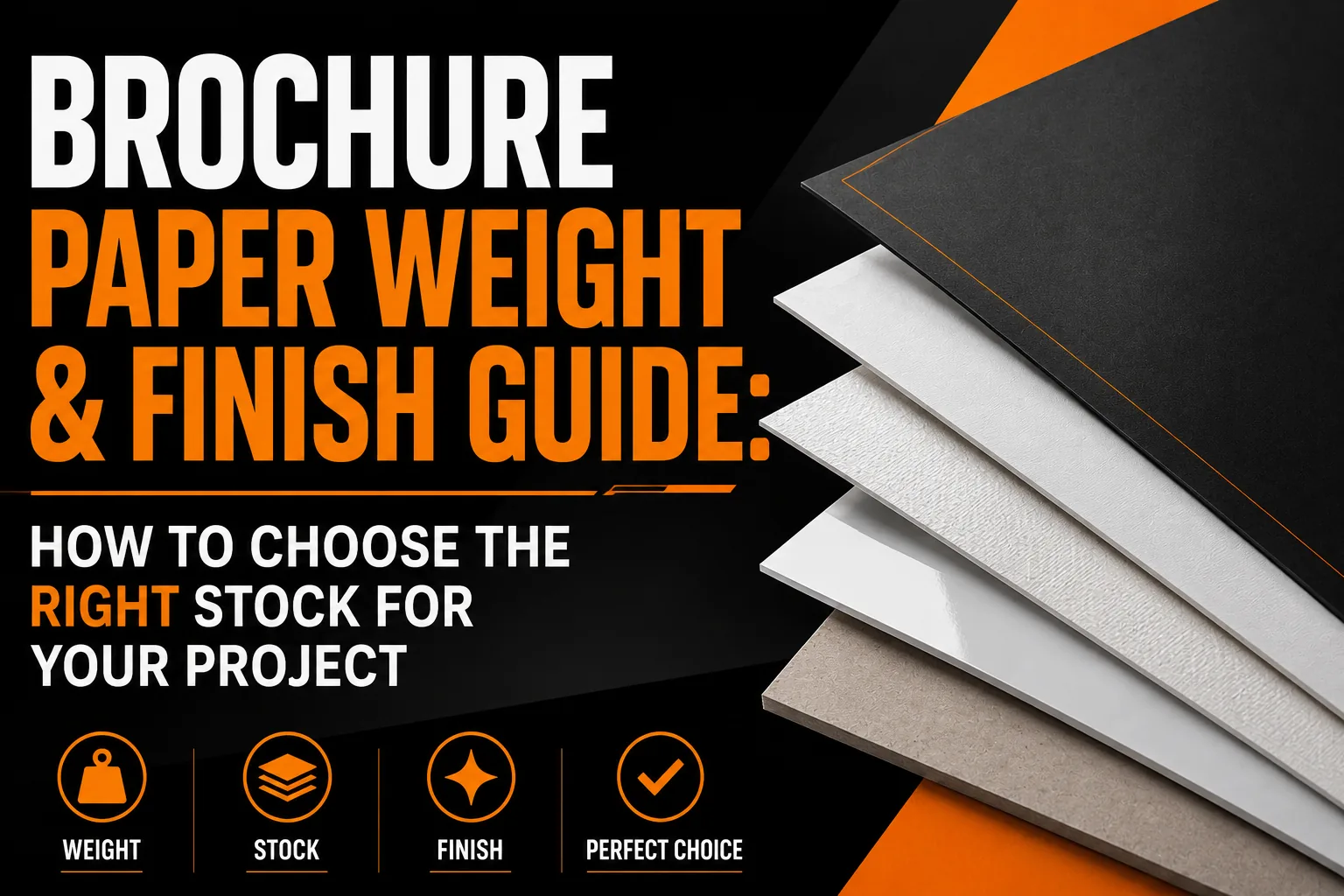
Brochure Paper Weight and Finish Guide: How to Choose the Right Stock for Your Project
The paper you choose for a brochure communicates brand quality before the reader has processed a single word. The weight of the paper in the hand, the reflectivity of the surface, the smoothness of the fold, these physical sensations form an immediate impression that either reinforces or undermines everything the design is trying to communicate. Choosing paper as an afterthought, or defaulting to whatever the printer recommends as standard, is a missed opportunity that is easy and inexpensive to correct with a little knowledge. This guide gives you everything you need to make the right paper choice for any brochure project.
Understanding Paper Weight: What GSM Means in Practice
Paper weight is measured in grams per square meter (GSM), the weight of a single square meter of the paper. Higher GSM means heavier, thicker, and more substantial paper. For context, standard office copy paper is 80gsm. A typical magazine is printed on 90gsm to 115gsm coated stock. Premium annual reports and luxury product brochures use 250gsm to 350gsm.
For brochures specifically, the GSM range in common professional use runs from 130gsm for standard volume print runs to 350gsm for high-end marketing materials. Within this range, each band communicates a distinctly different quality signal, and the right choice depends on the purpose of the brochure, the audience receiving it, and the brand positioning it needs to reinforce.
Paper Weight Recommendations by Brochure Type
Folded brochures, tri-fold, bi-fold, and z-fold formats, have a specific paper weight constraint imposed by the folding process. Paper below 130gsm feels flimsy and may show show-through from the reverse side on designs with heavy ink coverage. Paper above 170gsm tends to crack along fold lines unless machine-scored before folding, which adds a production step and cost. The practical sweet spot for standard folded brochures is 130gsm to 170gsm coated stock, with 150gsm being the most commonly specified weight for professional quality at reasonable cost.
For premium folded brochures where physical quality is part of the brand message, 200gsm to 250gsm coated stock with machine scoring before folding produces a noticeably more substantial result. The scored fold is clean and precise, the paper has significant weight in the hand, and the overall impression is of a document that has been produced with care rather than at minimum cost.
Unfolded single-sheet flyers and document inserts typically use 130gsm to 170gsm. Brochure covers for saddle-stitched or perfect-bound multi-page brochures use 250gsm to 350gsm to create a rigid, durable cover that protects the interior pages and signals quality at first touch.
The Three Coated Finishes: Gloss, Silk, and Matte
The surface finish of coated paper affects color reproduction, legibility, fingerprint resistance, and the perceived luxury of the final piece. Three finishes dominate professional brochure printing.
Gloss coated paper has a high-sheen reflective surface. Colors print vivid and saturated. Images have excellent definition and contrast. Text edges are sharp. Gloss is the optimal finish for image-heavy brochures where visual impact is the priority, product catalogues, food photography, architectural photography. The limitation of gloss is the fingerprint visibility and the glare from certain lighting angles, which can make text harder to read when the brochure is held at certain positions relative to a light source.
Silk coated paper, also called satin, occupies the middle ground between gloss and matte. It has a smooth, slight sheen that reduces glare compared to gloss while maintaining good color saturation. Text is comfortable to read without the reflectivity issues of gloss. Silk is the most versatile finish for mixed-content brochures that include both significant text and important imagery, and it is the most commonly specified finish for professional service firm brochures.
Matte coated paper has a non-reflective surface that reads as contemporary and premium. Text is exceptionally easy to read. Fingerprints are less visible. Colors print slightly less saturated than on gloss or silk, which some designers consider a limitation but which many brands deliberately prefer for the understated, sophisticated impression matte produces. Matte is the preferred finish for financial services, legal, consulting, and luxury brand brochures where the restraint of a non-shiny surface communicates appropriate seriousness.
Uncoated Stock: When to Specify It
Uncoated paper, paper without a surface coating, has a natural, slightly textured feel that communicates authenticity, craft, and environmental awareness. It is writable with all pen types, which makes it appropriate for brochures that include forms, sign-up sections, or any area where recipients need to write. It also has environmental associations that make it the preferred choice for sustainability-positioned brands.
The limitation of uncoated stock is that ink absorbs into the paper fiber rather than sitting on a surface coating, which produces slightly muted colors and less sharp text edges compared to coated alternatives. For text-heavy brochures with limited photography, this is acceptable. For image-heavy brochures where color accuracy and image sharpness are priorities, uncoated stock is generally not the right choice.
Specialty Finishes and Laminates
Several specialty finishing options are available that transform standard coated stock into something more distinctive and tactile. Soft-touch laminate applies a velvety, matte coating to the printed surface that creates a memorable tactile experience distinct from any standard finish. Gloss laminate adds a high-sheen protective coating that is more durable and water-resistant than unlaminated stock, useful for brochures distributed at outdoor events or in environments where they will be handled repeatedly. Spot UV adds a raised glossy coating to specific areas of the design on top of a matte laminated surface, creating visual and tactile contrast that draws attention to key elements like the logo or headline.
Frequently Asked Questions About Brochure Paper
What paper weight should I use for a folded brochure?
For folded brochures, the recommended weight is 130gsm to 170gsm coated stock. Below 130gsm the paper feels flimsy. Above 170gsm the paper may crack along fold lines without scoring. For premium brochures, 200gsm to 250gsm with machine scoring before folding produces a high-end result that communicates quality through physical sensation.
What is the difference between gloss, silk, and matte paper for brochures?
Gloss has a high-sheen surface that makes colors vivid and saturated, best for image-heavy brochures. Silk has a smooth semi-sheen that reduces glare while maintaining good color, best for mixed-content brochures. Matte has a non-reflective surface that feels contemporary and premium, best for text-heavy brochures and professional service firms where restraint signals appropriate seriousness.
Can I write on a matte brochure?
Uncoated matte paper is writable with most pens. Coated matte paper (which most professionally printed brochures use) can be written on with a ballpoint but may smear with felt-tip or roll-ball pens. If recipients need to write on the brochure, specify uncoated stock or include a separate uncoated insert for the writable section.
What paper finish is best for a luxury or premium brochure?
The most effective luxury paper choices are thick uncoated stock (300gsm to 350gsm) for a natural tactile feel, soft-touch laminated matte (200gsm to 250gsm) for a velvety high-end feel, or heavyweight coated silk (250gsm to 300gsm) with spot UV coating on key design elements. Each option communicates premium quality through physical sensation in ways that standard stocks cannot.
What is scoring and when is it needed for brochures?
Scoring is a mechanical crease applied along a fold line before folding. It is required for paper stocks above approximately 170gsm to prevent cracking or tearing along the fold. Without scoring, thick paper creates a ragged crease on the outside of the fold, particularly visible on coated stocks with heavy ink coverage near the fold line. Scoring should be specified as part of the print order for any brochure heavier than 170gsm.