
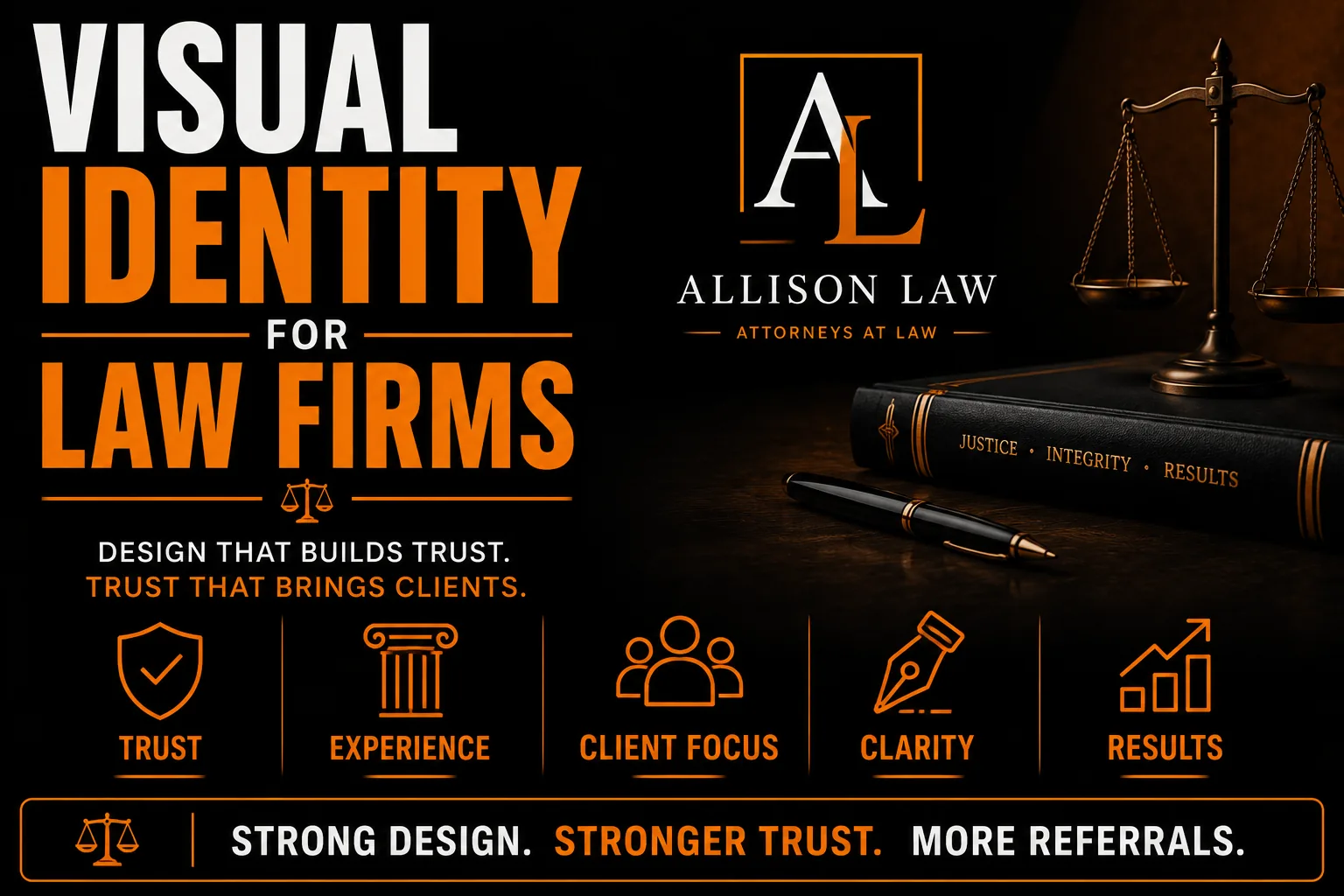
Visual Identity for Law Firms: Design Principles That Build Client Trust and Referrals
Legal services are one of the highest-trust professional categories. A client choosing a lawyer is often making that choice under stress, during a divorce, after an accident, facing a business dispute or a criminal charge. They are evaluating who they can trust with a matter that may significantly affect their finances, their freedom, or their family. In this evaluation, visual identity plays a role that most lawyers systematically underestimate. This guide covers the design principles that make law firm branding work, and the specific decisions that separate law firms whose visual identity actively wins business from those whose branding is simply adequate.
Key takeaways
- Give the typeface choice serious strategic attention, since most law firm logos rely mainly or entirely on type.
- Choosing navy blue is the safest option for a law firm, but it offers no visual differentiation from most competitors.
- Use a purely typographic logo when named partners drive business or when the lettering of the firm name is distinctive.
Why Law Firm Visual Identity Matters More Than Most Lawyers Think
The legal profession’s historical skepticism of marketing has created a significant and exploitable gap in most markets. In most cities and practice areas, the majority of law firms have visual identities that are functionally indistinguishable, similar colors, similar typefaces, similar compositions, similar degrees of effort invested in the outcome. A firm that invests seriously in its visual identity does not need to be dramatically different to stand out, it needs only to be clearly more professional than the undifferentiated average.
The trust calculus for a prospective legal client is straightforward: they are looking for signals that the firm they choose is competent, established, and will take their matter seriously. Visual identity is one of those signals, and it operates before any conversation, before any review reading, and before any referral is followed up. A website, a business card, and an office environment that communicate clear professionalism and attention to detail signal that the firm applies the same standard to its legal work. A visual identity that looks like it was assembled without care signals the opposite, and in a high-stakes purchase context, that negative signal is disproportionately weighted.
Typography: The Most Important Design Decision for Law Firm Branding
In law firm branding, typography typically does more work than any graphic element. Most law firm logos are primarily or exclusively typographic, the firm name in a carefully chosen typeface, with or without a simple graphic mark. The typeface choice is therefore the primary design decision and deserves significant strategic attention.
Serif typefaces remain the most effective choice for most law firm logos because their associations align precisely with what clients are evaluating: tradition, authority, depth, and established expertise. The specific serif subcategory matters significantly. Old-style serifs, Garamond, Caslon, communicate warmth alongside authority, appropriate for family law, estate planning, and practices where personal relationship is central. Transitional serifs, Baskerville, Times, communicate formal institutional authority, appropriate for litigation, corporate law, and practices where professional distance is valued. Modern serifs, Didot, Bodoni, communicate premium positioning and sophistication, appropriate for high-end practices serving business clients.
Sans-serif law firm logos are increasingly common for practices that want to communicate contemporary relevance alongside authority, particularly corporate and commercial practices, technology law firms, and practices targeting startup and growth-stage companies. The humanist sans-serif category performs particularly well in this context: it communicates modernity without sacrificing the warmth and approachability that clients in any legal context ultimately require.
The Color Decision: Differentiation Within Appropriate Boundaries
Navy blue’s dominance in legal branding is so complete that choosing navy is simultaneously the safest and the least differentiating decision available. In most markets, the majority of law firms use navy as their primary color, which means that navy provides no visual differentiation whatsoever between competing firms in the same category.
A firm that chooses deep forest green, rich burgundy, or sophisticated dark grey as its primary color is choosing a color that communicates equally appropriate professional qualities, trust, stability, authority, while creating immediate visual recognition relative to a field dominated by navy. This is not a risky choice; it is a strategically rational one. The color still communicates the required trust signals. It also creates a visual marker that makes the firm immediately distinguishable in every directory listing, every referral conversation, and every digital impression where it appears alongside competitors.
The Mark: When to Use One and When to Use Type Only
Many of the most effective law firm logos are purely typographic, the firm name in a well-chosen typeface with intentional spacing and perhaps a thin rule or dividing element. This approach is appropriate and often optimal for firms where the reputation of named partners is the primary business development driver, where the letterform treatment of the firm name is sufficiently distinctive, or where a graphic mark would feel decorative rather than communicative.
A graphic mark is most valuable for law firms in three specific situations: firms with names that benefit from a visual anchor (three-partner name combinations that are difficult to remember benefit from a mark that creates a single visual hook), firms that operate across multiple practice groups where sub-brand differentiation serves a useful purpose, and firms that compete in markets where visual recognition across repeated impressions matters, firms that advertise broadly in local markets where the mark needs to work on billboards, bus shelters, and broadcast media without the firm name always visible.
The Letterhead Test: Where Law Firm Identity Does Its Most Important Work
In most professional services categories, digital touchpoints have overtaken print as the primary brand experience. In legal services, the opposite is true for established practices. Legal correspondence, demand letters, retainer agreements, settlement proposals, court filings, still carries the weight of the firm’s reputation in the form of physical documents bearing the firm’s visual identity. A letterhead that looks and feels premium, with an embossed or engraved logo on heavy cotton-content paper, communicates the firm’s standards as effectively as any website or advertisement.
Every law firm logo must be tested specifically for letterhead applications. The logo must work in a single color (typically navy or black) on white stock. It must be legible at the small scale of a letterhead header, typically 6 to 8cm wide. And it must be suitable for professional embossing or letterpress printing if the firm uses premium stationery, which means it must be fully vectorized with sufficient detail in the mark to produce a clean impression in blind embossing.
Frequently Asked Questions About Law Firm Visual Identity
What should a law firm logo communicate?
A law firm logo must communicate authority, stability, trustworthiness, and expertise, the qualities clients evaluate when choosing legal representation. It should also communicate the firm’s specific practice area positioning. A family law firm needs to communicate approachability alongside competence. A corporate M&A practice needs sophistication. The general trust signals are constant; the specific positioning signals vary by practice area and target client.
Should a law firm logo include the partners’ names?
Partner name branding builds personal reputation equity but creates succession challenges. Firm name branding builds institutional equity that survives personnel changes. Most firms below five partners brand under partner names because personal reputation drives business development. Firms above ten partners increasingly benefit from institutional branding that can scale without renaming at each partnership change.
What colors are most appropriate for a law firm logo?
Navy blue dominates law firm branding for its trust and authority associations. Deep burgundy communicates tradition for established litigation firms. Forest green suits environmental law and estate planning practices. Dark grey communicates contemporary sophistication for corporate and commercial practices. Black communicates uncompromising authority for the most premium-positioned firms.
How does a law firm logo need to perform technically?
Law firm logos appear on embossed letterhead and envelopes, court documents in black and white, office signage in metal or etched acrylic, premium business cards with specialty finishes, and digital platforms. All applications require vector source files and well-tested black-and-white versions that perform as cleanly as the full color version.
Should a law firm invest in a full brand identity or just a logo?
A law firm above five attorneys serving clients with significant legal matters benefits meaningfully from a full brand identity. The additional investment in letterhead design, website visual identity, business card standards, and a basic brand guide produces compound returns. The legal profession’s fee levels mean that even one additional client attracted partly by professional presentation generates returns that exceed the entire brand investment multiple times over.