
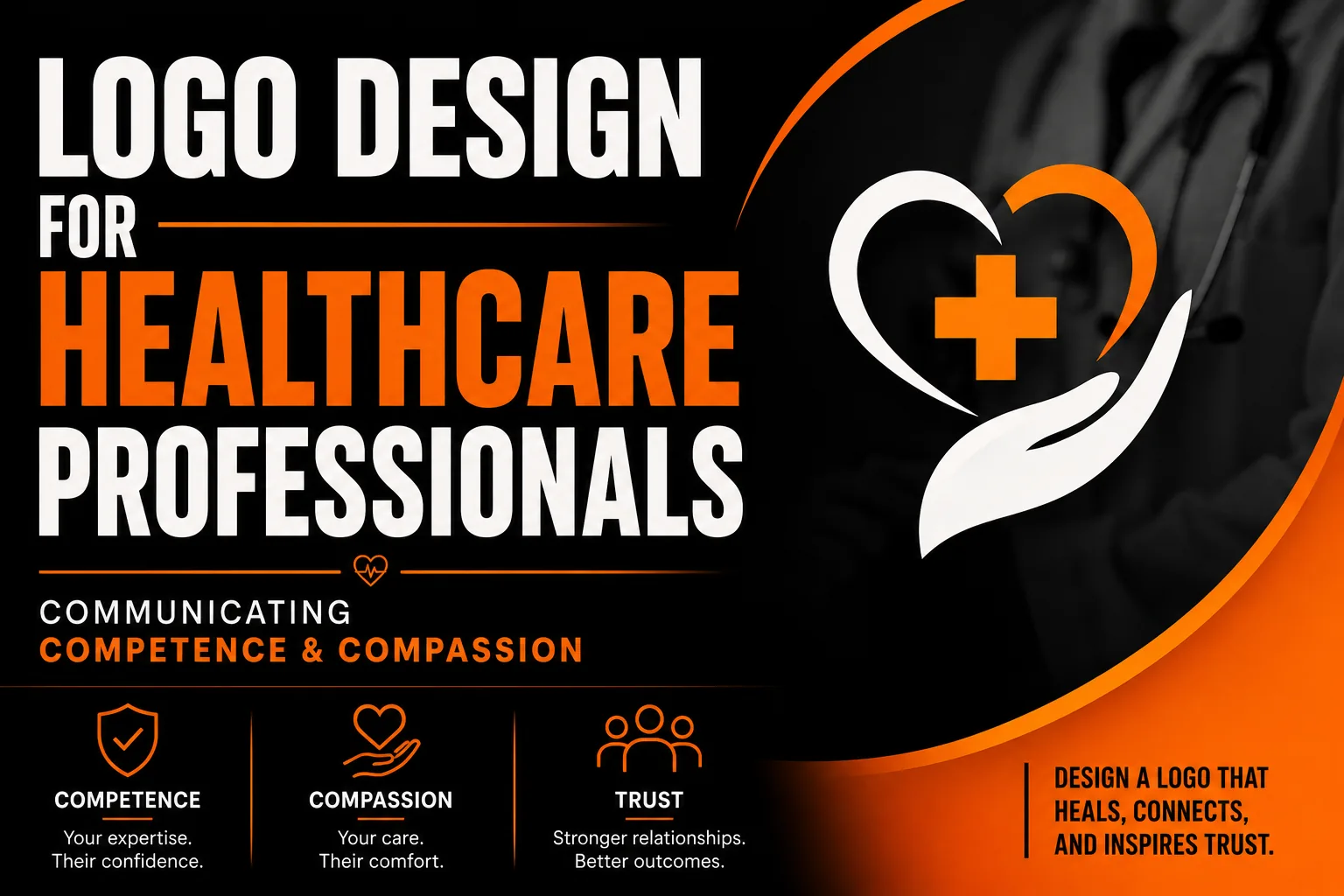
Logo Design for Healthcare Professionals: Communicating Competence and Compassion
A healthcare logo carries a communication burden that logos in most other categories do not. It must simultaneously signal clinical competence, reassuring patients that they are in capable, expert hands, and human warmth, reassuring them that they will be treated as a person, not a case number. These two signals are not in conflict, but achieving both in a single visual identity requires more strategic precision than most generic healthcare logos demonstrate.
Key takeaways
- Make your logo signal both clinical competence and human warmth, since patients weigh both before choosing a provider.
- Avoid overused symbols like the heartbeat line, red cross or stethoscope, which say healthcare but differentiate nothing.
- Skip heavy geometric display fonts and decorative scripts, and favor formal serifs or humanist sans-serif typefaces.
The Two Communication Priorities Every Healthcare Logo Must Balance
Competence and compassion are the two primary drivers of patient trust. Research on patient decision-making consistently shows that patients evaluate both dimensions before selecting a provider: they need to believe the provider is technically skilled, and they need to believe the provider genuinely cares about them as a person. A logo that communicates only one of these qualities leaves a gap that competitors can fill. A logo that communicates competence without warmth may attract credential-focused patients but struggles with anxious patients who need warmth as much as expertise. A logo that communicates warmth without competence may feel approachable but can struggle in competitive markets where clinical credibility is the primary selection criterion.
Color Strategy for Healthcare Positioning
Color in healthcare branding communicates both the clinical register of the practice and the specific emotional tone it aims to create in patient interactions. Navy and medium blue communicate institutional trust, clinical authority, and professional reliability, the most broadly used and appropriate colors across all healthcare specialties. Teal communicates the trust of blue with an added dimension of natural healing and whole-person wellness, particularly effective for integrative medicine and mental health practices. Soft green communicates growth, natural healing, and vitality, working well for nutrition, lifestyle medicine, and naturopathic practices. Warm coral and terracotta are emerging as differentiators for practices seeking to communicate human warmth as a primary brand characteristic.
Typography for the Professional-Warmth Balance
Formal serif typefaces communicate professional authority and established expertise, positioning a practice as clinically serious and well-established. Humanist sans-serif typefaces communicate modernity and accessibility alongside professionalism, feeling contemporary and approachable without sacrificing credibility. The worst typographic choices are at both extremes: heavyweight geometric display fonts that look more tech startup than healthcare, and decorative script fonts that look more artisanal boutique than clinical practice.
Symbols and Icons: What Works and What to Avoid
The most overused symbols in healthcare logo design, the heartbeat line, the red cross, the caduceus, the stethoscope, have been used so extensively that they communicate “healthcare” generically but differentiate nothing specific. More effective approaches use abstract marks that communicate the specific values and personality of the practice without the generic cliché of the overused category symbols. A flowing form suggesting both growth and calm, a circular mark suggesting wholeness, a subtle botanical element referencing the organic connection between nature and health, these create distinctive identity without relying on clichéd shorthand.
Frequently Asked Questions About Healthcare Logo Design
What symbols should a healthcare logo avoid?
Avoid the caduceus (widely misused and clichéd), the red cross (legally protected in many jurisdictions), and abstract heartbeat or ECG line graphics that communicate nothing distinctive. These signals may identify “healthcare” but do not differentiate any specific practice from the generic category.
What colors communicate best in healthcare logo design?
Blue communicates trust and calm across all demographics. Teal combines trust with natural healing associations. Soft green communicates growth for preventive care practices. Warm coral communicates human warmth and approachability. Pure white paired with any of these communicates cleanliness and clinical precision.
Should a healthcare logo include the medical credential or specialty?
Including the practice specialty as a descriptor beneath the logo mark is generally valuable, it communicates immediately who the practice serves. Credentials are optional and can make the logo feel more corporate or less approachable depending on positioning goals.
What are the key applications a healthcare logo must be tested on?
Test on clinic exterior signage, appointment cards and prescription pads, patient intake forms in black and white, the website header, healthcare directory profiles, embroidered staff uniforms, and patient portal or mobile app interfaces at small icon scale.
How should a healthcare practice introduce a new logo to existing patients?
Send a brief notice through the patient newsletter or patient portal before launch day, with positive framing about what the new look represents. Update all digital touchpoints simultaneously on launch day. For established practices, acknowledge the history while framing the new look as evolution rather than a break from the past.