How to Vectorize a Photo of an Old Logo: Recovering a Vintage Brand Identity
Family businesses, decades-old companies, and organizations with long histories frequently encounter the same problem: a logo with real historical and emotional value that exists only as a photograph of an old sign, a scan of yellowed letterhead, or a blurry image on a decades-old business card. The original digital files, if they ever existed, are long gone. The designer who created the logo may be unreachable or may have no record of the files. And yet the logo represents brand equity that the organization has spent years or decades building and does not want to abandon. Professional logo recovery and vectorization is the solution. This guide explains the process, what to expect, and how to provide the best possible source material.
Why Organizations Want to Recover Old Logos Rather Than Design New Ones
The impulse to modernize, to commission a fresh new logo rather than recover the old one, is understandable. A new logo can be designed to contemporary standards, delivered in all required formats, and optimized for every current application from day one. So why do so many organizations choose recovery over replacement?
The answer is brand equity. In the specific context of family businesses, long-established local companies, and organizations with community roots, the existing logo carries decades of recognition that a new design cannot replicate. Long-term customers, community members, and institutional partners recognize the logo and associate it with a history of reliable service that new visual identities cannot inherit automatically. For these organizations, the cost of rebuilding recognition from scratch, in the advertising investment, the relationship reinforcement, and the market re-education required to establish a new identity, far exceeds the cost of recovering and modernizing the existing one.
Additionally, recovered vintage logos often have an authenticity and character that contemporary designs struggle to replicate. The design conventions of earlier decades produce marks that feel genuinely historical, a quality that resonates powerfully with audiences in an era saturated with algorithmically generated visuals that lack any sense of origin or history.
Assessing What You Have: The Source Image Audit
The first step in any logo recovery project is assembling every available source of the original logo and evaluating what each provides. Collect everything: photographs of exterior signs, scans of business cards, letterhead, brochures, certificates, product packaging, embroidered items, vehicle signage, and any digital images of the logo in any format. Each source may provide different information, a photograph of a sign may show the composition and proportions clearly while a scanned business card may show the fine typography details more accurately. Together, multiple imperfect sources often provide enough information to reconstruct the logo with high fidelity.
Evaluate each source for resolution, clarity, color accuracy, completeness, and angle distortion. A high-resolution scan of an original printed piece, even if aged and slightly discolored, is typically the best source material. A mobile phone photograph taken from an angle of an old framed sign is the least ideal but can still be workable if no better source exists. Inform your designer about every source available and let them assess which combination provides the most complete reference for reconstruction.
The Reconstruction Process: What Professional Vectorization Involves
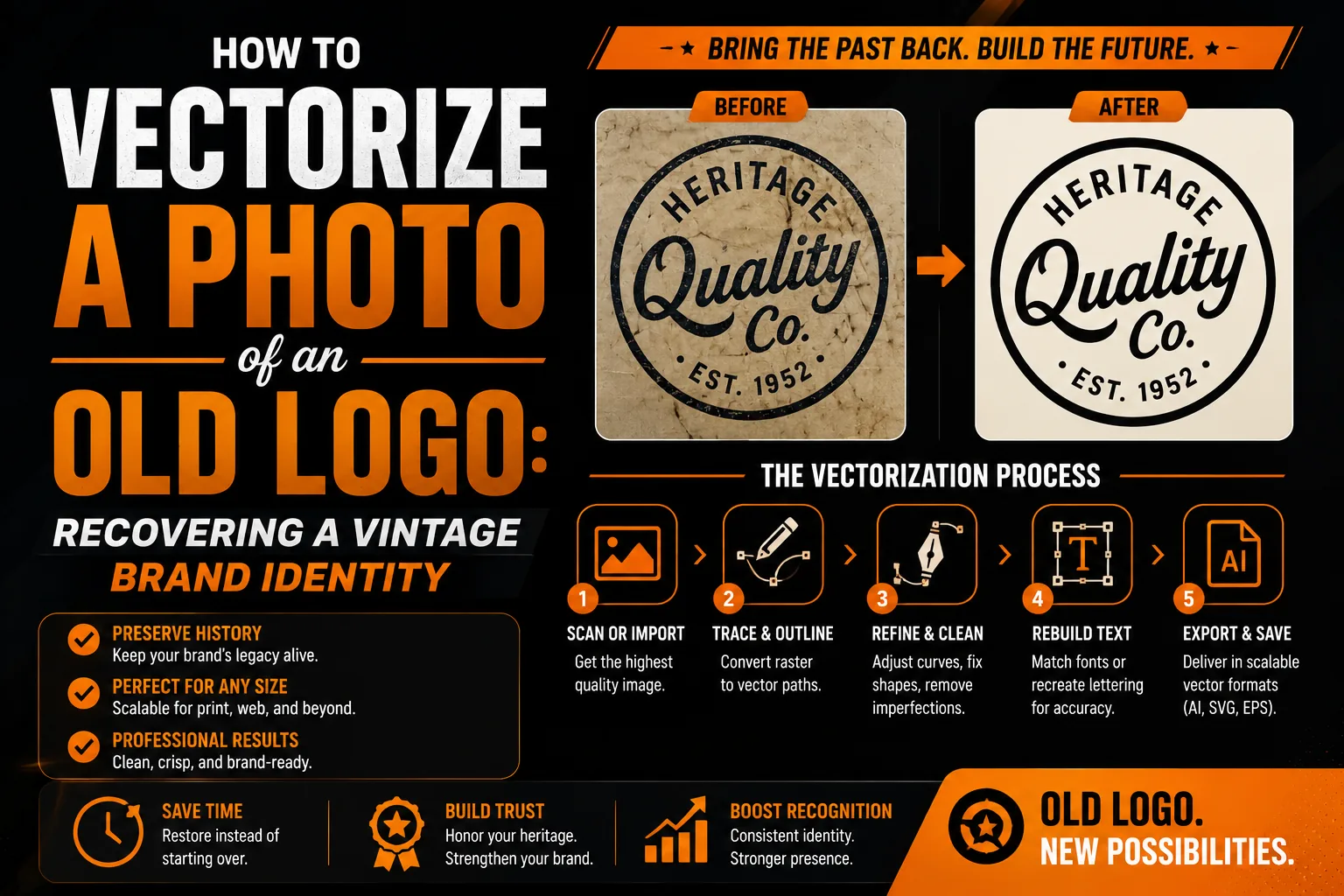
Professional logo recovery from an old image is a manual process. A designer opens the best available source image as a reference layer in Adobe Illustrator and redraws each element of the logo as clean vector paths, tracing the original design with precision, making judgment calls where details are unclear, and reconstructing damaged or missing elements based on the visible portions and design logic of the original.
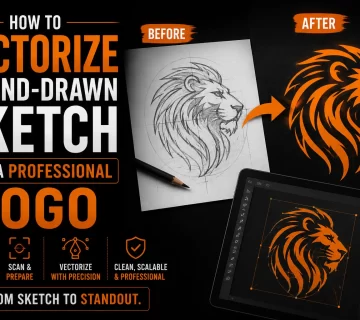
Typography is typically the most technically challenging element to recover. If the original typeface can be identified, using font identification tools like WhatTheFont, the text can be reset in the original font and refined to match the original proportions, which produces a more authentic and technically superior result than tracing the letterforms by hand. If the original typeface is unavailable, the closest available equivalent is used or the letterforms are hand-drawn as custom outlines. For a related practical example, see our guide to turning a hand-drawn sketch into a vector logo.
Complex decorative elements, ornate borders, detailed emblems, intricate badge designs, require the most time and skill to reconstruct. These elements are often partially obscured in old photographs and must be completed using symmetry, pattern logic, and design judgment about what the original likely looked like. This reconstruction work is where the experience of the designer doing the recovery has the most impact on the quality of the final result.
Modernization Decisions: What to Preserve and What to Improve
Most logo recovery projects involve at least some degree of modernization alongside pure vectorization. The question of what to preserve exactly and what to improve is the most important strategic decision in the project, and it should be made deliberately with the organization’s leadership rather than left entirely to the designer’s judgment.
Elements that are almost always preserved exactly are the overall composition and structure of the mark, the primary typographic treatment, and the character elements that make the logo distinctive and recognizable. Elements that are often improved are the precision of geometric forms, the consistency of line weights, the quality of the typographic spacing, and the technical execution of decorative details that may have been limited by the printing technology of the original era. Gradients and tonal effects that existed in the original but create problems in modern production applications may be simplified to flat color with the client’s approval.
Delivering a Complete File Set After Recovery
The deliverable from a professional logo recovery project is not just the vectorized source file, it is a complete brand file set equivalent to what would be delivered for a new logo design project. This includes the recovered logo in AI, EPS, SVG, and PDF formats, PNG exports at multiple sizes with transparent backgrounds, black and white versions, reversed versions for dark backgrounds, and where applicable a simplified version for embroidery use. If the recovery involved color decisions, interpreting aged or faded colors from old photographs, the deliverable should also include documented color codes in Pantone, CMYK, RGB, and HEX to prevent color inconsistency in future production.
Frequently Asked Questions About Old Logo Vectorization
Can a logo be recovered from a very old or damaged photograph?
Yes, professional logo recovery is routinely successful even from significantly degraded source images. The key is having enough visual information to reconstruct the design intent. Missing details can be reconstructed using design judgment, historical reference materials, or deliberate modernization of unclear elements. The older or more damaged the source, the more the final result represents a recovery plus refinement rather than a pure faithful reproduction.
Is vectorizing an old logo different from designing a new logo?
Vectorization of an old logo aims to faithfully reproduce the original design in a production-ready format, making as few changes as possible while improving technical quality. Designing a new logo creates an entirely new visual concept. The two processes may be combined when an old logo needs both vectorization and modernization, preserving core elements with historical recognition value while improving execution quality.
How do I find the original font used in an old logo?
Tools like WhatTheFont by MyFonts, Font Squirrel’s identifier, and Adobe Fonts’ visual search can identify fonts from images with good accuracy. Upload a clean, cropped image of the text and the tool will suggest matching typefaces. For very old logos, the original font may no longer be available, the closest equivalent or custom redrawing of the letterforms is used in those cases.
Should I update an old logo when vectorizing it, or keep it exactly as it was?
The decision depends on the business context and the source of the logo’s value. If the old logo has strong historical recognition, faithful preservation is usually the right approach. If the logo is being recovered primarily for a production-quality file, vectorization is an opportunity to refine proportions and improve technical execution while preserving the core identity. Most clients choose a middle path: exact preservation of the primary mark with subtle refinements to elements that have dated or create technical production problems.
What is the best source material for old logo vectorization?
Best sources in order of preference: original printed materials at the largest available size (letterhead, certificates, large-format brochures), large embroidered items, photographs of original signage, scanned business cards or smaller print materials, and mobile phone photographs as a last resort. Multiple reference images from different sources, combined, often provide enough information to reconstruct even significantly damaged logos accurately.