How to Structure a Service Brochure That Converts Readers Into Clients
Most service brochures fail before they are read. They lead with the company name and logo on the cover. They fill the inside panels with capability lists that sound identical to every competitor. They end with a generic “contact us” and a phone number. The reader has seen this format dozens of times, processes it as marketing noise, and sets it aside. This guide shows you the structural approach that produces service brochures that actually get read, and that move readers from awareness to action.
Key takeaways
- Lead the cover with a benefit-driven headline about the reader’s problem rather than with your company name.
- Make the back panel work on its own with your call to action, full contact details and a QR code to a landing page.
- Use the center spread for outcomes, process explanations and specific results instead of a list of features.
Understanding How Readers Actually Process a Brochure
Before designing any brochure, it is essential to understand the real reading behavior it will encounter. Research on print marketing materials consistently shows a predictable sequence. The reader picks up or receives the brochure and makes a decision in two to four seconds about whether to engage further or discard it. This decision is based almost entirely on the cover. If the cover survives the initial scan, the reader flips to the back panel next, not to the inside. The back panel is the second most-viewed surface of any brochure. Only then, if both the cover and the back have been engaging, does the reader open the brochure and scan the inside panels.
This reading pattern has three critical implications for structure. The cover must earn continued reading through a compelling promise or question, not through brand identification. The back panel must function as a complete, standalone piece that communicates the core offer and provides a clear path to action. The inside panels must deliver on the cover’s promise with sufficient evidence to justify contact.
The Cover: One Job Only
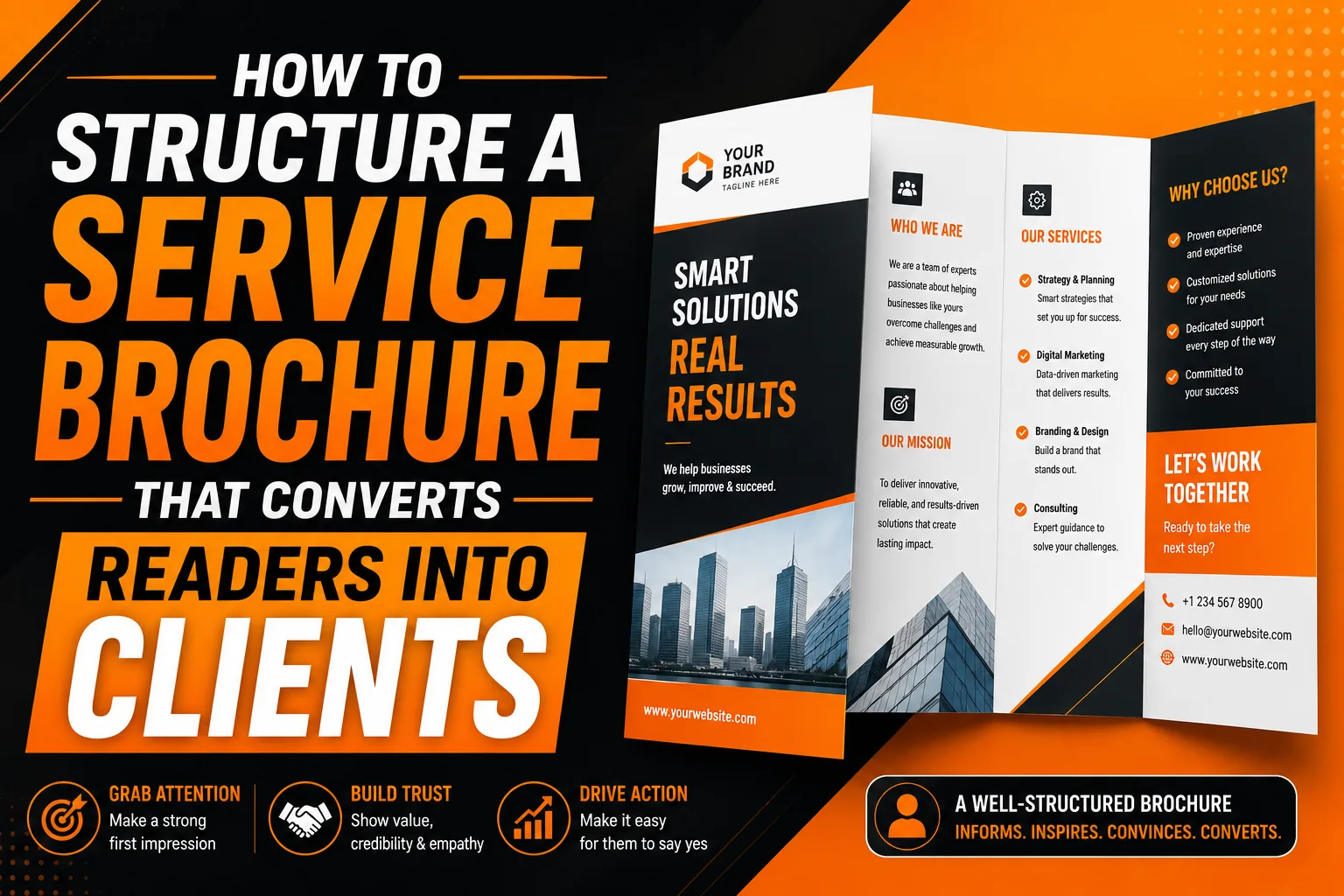
The cover’s only job is to make the reader want to open the brochure. It accomplishes this by communicating a specific promise, addressing a specific problem, or describing a specific situation that the ideal client recognizes as their own. The most effective covers lead with a benefit-driven headline, not the company name, not a generic tagline, not a list of services.
A headline like “Stop Losing Clients to Competitors Who Look More Professional” is more effective than “Professional Graphic Design Services” because it describes a real problem the reader may be experiencing and implies a specific solution. The company name and logo should appear on the cover, but in a secondary position, at the bottom or as a small element that anchors the cover without dominating it.
A single strong visual, a photograph showing the result your service produces, a client in a recognizable situation, or a powerful abstract image that complements the headline, reinforces the headline and makes the cover visually compelling. Avoid stock photography that feels generic. A real client photograph or a purposeful original image dramatically outperforms generic stock in the credibility signal it sends.
The Inner Flap: Validate That the Reader Is in the Right Place
When a reader opens the brochure, the first panel they see is the inner flap, the narrow right panel that was visible when the brochure was closed. This panel has one job: to confirm that the reader is in the right place by addressing a specific problem, situation, or outcome that they recognize as their own.
The most effective inner flap content is a brief, specific description of the problem your service solves, written in the language your client would use to describe it themselves. Following the problem statement with a single, specific testimonial from a client who experienced the same problem before working with you is an extremely powerful combination, it validates the problem, demonstrates empathy, and introduces social proof simultaneously.
The Center Spread: Your Solution With Evidence
The center of the brochure, the two largest panels that are visible when the brochure is fully open, is where your service is described in enough detail to build conviction. This is not the place for feature lists. It is the place for outcome descriptions, process explanations that reduce anxiety about the unknown, and evidence in the form of specific results.
A case study format works particularly well in this section: briefly describe a client who had a specific problem, explain what your service provided, and state a specific measurable result. “Increased online quote requests by 340 percent within 90 days” is dramatically more convincing than “improved brand visibility.” Specificity is the most powerful tool available to any marketing copy.
The Back Panel: Your Standalone Conversion Tool
The back panel must work independently of everything else in the brochure. It is the panel visible when the brochure sits in a display rack, when it is passed face-down across a desk, and when it is the only part a busy reader examines before deciding whether to call. It must contain your primary call to action, complete contact details including phone, email, and website, a QR code linking to a relevant landing page, and any special offer or first-step incentive.
The call to action on the back panel should be specific and low-friction. “Book your free 30-minute brand audit at [website]” is more effective than “Call us today” because it specifies what the reader will receive, removes uncertainty about what the call involves, and provides a path to action that does not require phone contact for readers who prefer digital first steps.
Frequently Asked Questions About Service Brochure Structure
How much text should a service brochure contain?
A tri-fold service brochure should contain no more than 300 to 400 words of body text across all six panels combined. Readers scan brochures before they read, a brochure that looks text-heavy is set aside without being read at all. Use headlines, subheadings, and bullet points to make critical information accessible in under 30 seconds of scanning. Every word that does not move the reader toward action should be cut.
Should a service brochure include pricing?
For standardized services, including price ranges increases qualified lead quality significantly, prospects who contact you have already self-qualified on budget. For bespoke services, include a starting price or minimum engagement level rather than leaving price completely absent, which often leads to low-quality inquiries from prospects far outside your budget range.
What is the ideal size for a professional service brochure?
The tri-fold format on A4 or US Letter paper is the most practical size because it fits standard envelopes, display racks, and pockets without modification. The resulting panels at A4 size are approximately 99mm wide, wide enough for clear typography and imagery while maintaining a compact format.
How many services should a single brochure cover?
A single service brochure is most effective when it focuses on one primary service or one closely related cluster of services. Trying to present five or six distinct services creates a cluttered document that communicates none of them clearly. If your business offers multiple distinct services to different audiences, create separate brochures for each.
What should the call to action in a service brochure say?
The most effective CTAs are specific about what the prospect will receive and what the next step involves. “Call us for a free 30-minute consultation” outperforms “Contact us” because it specifies the format and removes uncertainty about what happens next. The CTA should be visible at a glance on the back panel without requiring the reader to open the brochure.