Startup Logo Design: Building a Scalable Identity From Pre-Seed to Series A
A startup’s visual identity has to do something that most established brand identities do not: it has to work for a business that may look fundamentally different in eighteen months. The product may pivot. The target market may shift. The positioning may evolve from “affordable alternative” to “enterprise premium” in two funding rounds. A logo designed too narrowly for the current moment creates a rebrand cost at exactly the wrong time, when resources are needed for growth, not visual housekeeping. This guide covers how to design a startup identity that is both right for today and scalable through the growth stages ahead.
The Startup Brand Paradox
Startup founders face a genuine tension in visual identity decisions. On one hand, spending significant resources on branding before product-market fit is confirmed is a questionable allocation when every dollar is needed for product development, customer acquisition, and team. On the other hand, a logo that communicates the wrong level of professionalism or ambition creates friction in the investor conversations, partnership discussions, and enterprise sales conversations that are often critical to early-stage growth.
The resolution to this tension is not choosing between investing and not investing, it is calibrating the investment to the stage and ensuring that whatever is invested produces a result that will not need to be redone in the near term. A $400 logo designed strategically for a specific positioning and target audience will outperform a $4,000 logo designed without strategic direction, and will serve the business longer before a genuine strategic rebrand is needed.
Stage-Appropriate Visual Identity Investment
At the pre-revenue idea validation stage, visual identity should be functional but not a priority. A clean, simple wordmark from an early-career designer or a well-executed template serves the purpose of making the company look organized and intentional without absorbing resources that belong in product development. The bar at this stage is “does not embarrass us in an initial conversation” rather than “communicates our brand strategy precisely.”
At the initial product launch with paying customers stage, the logo needs to support customer acquisition and retention. Customers who are paying for a product expect it to be presented with a level of visual professionalism consistent with the price they are paying. A startup charging $500 per month for a B2B SaaS product needs a logo and visual identity that communicates the same competence as the product. This stage warrants an investment of $500 to $1,500 in a professional freelance designer who can deliver a complete logo file set with the strategic foundations (color palette, typography) needed to apply the brand consistently.
At seed funding stage or when entering serious competitive market positioning, the identity needs to perform in investor presentations, partnership conversations, and enterprise sales contexts where visual credibility materially affects outcome. This stage warrants $1,500 to $5,000 from a senior designer or boutique brand agency who can deliver not just a logo but the strategic brand foundation, positioning rationale, visual identity system, application guidelines, that gives the entire team a shared framework for brand decisions going forward.
Designing for Scalability: The Four Principles
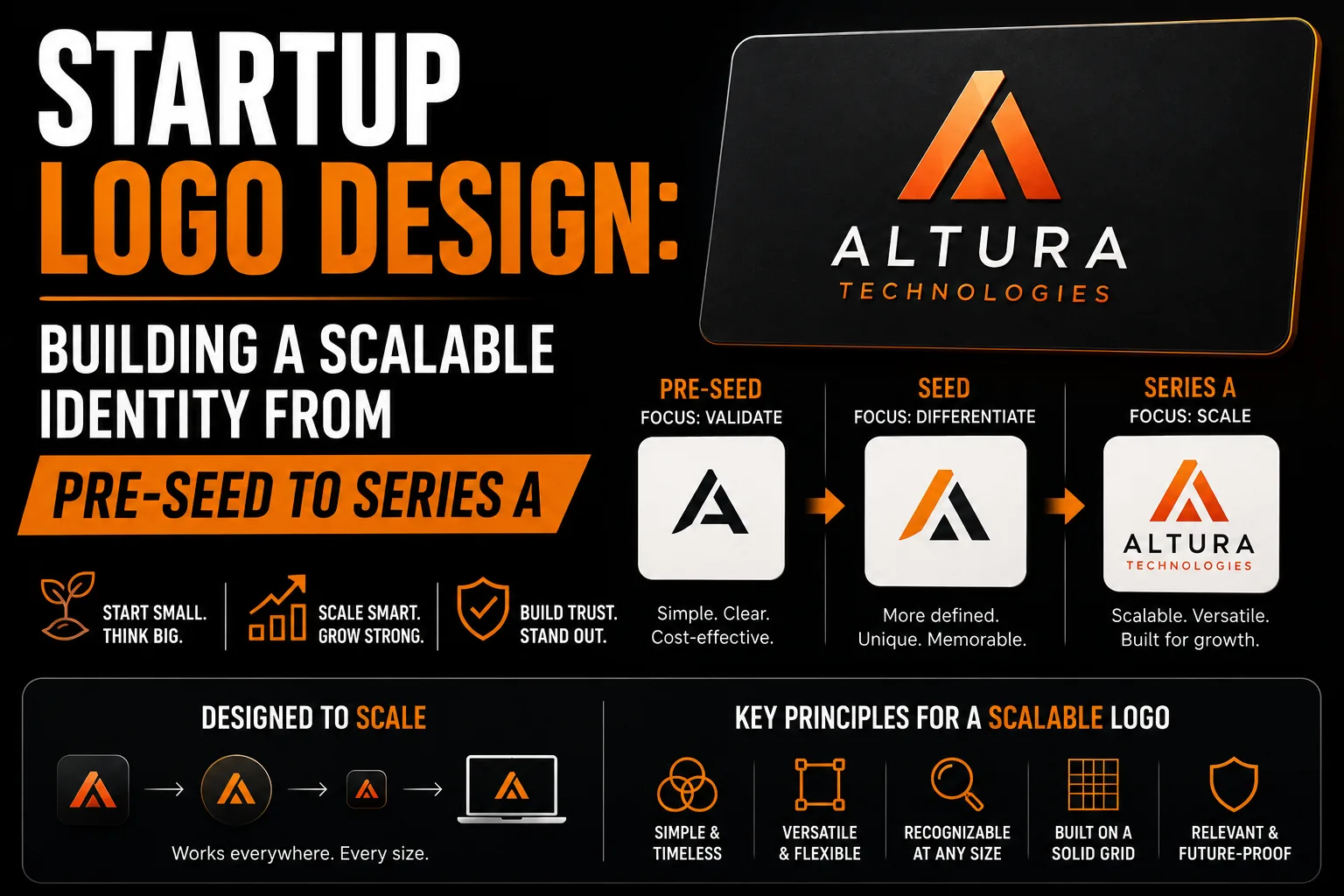
Simplicity is the foundation of scalability. A complex logo with fine details, multiple colors, and intricate elements works beautifully at large scale in a controlled marketing context and fails consistently in the real production applications a growing startup encounters: app icon at 32px, Slack profile picture, embroidered merchandise, outdoor event signage, favicon in a browser tab. Design for the smallest application first and verify the logo works at that scale before evaluating it at larger sizes.
Positioning breadth ensures the logo does not become wrong as the business evolves. A logo that communicates “affordable option for solopreneurs” becomes actively misleading when the company repositions for enterprise clients. A logo that communicates “innovation and technology” remains appropriate for a company that applies technology to different market problems over time. Brief the designer on your three-year vision, not just the current state of the product, and design to the destination rather than the starting point.
Single-color functionality is a practical scalability requirement. Early-stage startups frequently encounter applications where only one color is available or affordable, single-color embroidery, black-and-white press materials, monochrome product packaging, single-color merchandise. A logo that only works in its full-color version requires redesign to accommodate these applications. Brief your designer explicitly to deliver and test a single-color (black) version that works as well as the primary color version.
Distinctiveness beyond current context ensures the logo remains recognizable as the brand matures and the competitive landscape changes. A logo that is distinctive because it uses a visual trend popular in the founding year, a particular gradient style, a fashionable font category, a specific geometric pattern, will date rapidly as that trend becomes associated with a particular moment rather than a timeless identity. Design for recognition over time, not recognition of this specific moment.
The Pitch Deck Test: What Investors Actually Notice
Investor presentation aesthetics matter more than most founders believe and less than most brand agencies suggest. The most accurate framing is that visual presentation creates a threshold effect: below the threshold, it creates negative signals about team quality and attention to detail; above the threshold, it is a neutral factor that does not meaningfully differentiate between investment opportunities of similar quality.
The threshold for investor presentation is not high, it is “looks like a professional organization that pays attention to how it presents itself.” A clean, simple logo applied consistently across the pitch deck, a coherent color palette, and professional typography clear that threshold. An obviously AI-generated logo, inconsistent color use, and stock photography that appears on twenty other startups’ decks does not. Reaching the threshold is a worthy goal; exceeding it significantly by investing in elaborate visual identity at the pre-seed stage is unlikely to produce proportionate fundraising returns.
Frequently Asked Questions About Startup Logo Design
How much should a startup spend on a logo?
At pre-revenue validation stage, $0 to $500 is appropriate. At initial product launch with paying customers, $500 to $1,500 from a professional freelance designer produces a quality identity that serves through early growth. At seed funding stage or serious competitive market entry, $1,500 to $5,000 from a senior designer or boutique agency produces an identity robust enough for fundraising and enterprise sales contexts.
Should a startup design its logo for today’s stage or for where it plans to be?
Design for where the business will be in three to five years, not for where it is today. A logo designed to communicate the scrappy energy of a two-person founding team will create the wrong impression when pitching institutional investors or enterprise clients two years later. The cost of designing a logo that must be replaced because it no longer fits the positioning is significantly higher than getting the positioning right once.
What makes a startup logo scalable?
A scalable startup logo is simple enough to work at app icon scale and at billboard scale simultaneously, communicates a positioning broad enough to survive product evolution and market pivots, works in a single color for early-stage production and in full color for mature-stage marketing, and is distinctive enough to remain recognizable as the brand matures without relying on visual trends that date quickly.
How important is a logo for fundraising?
A professional logo is a meaningful but not decisive factor. Investors evaluate teams, markets, traction, and unit economics far more than brand aesthetics. However, a logo that actively undermines credibility creates a negative signal about how the team presents itself. In competitive fundraising situations, the quality of visual presentation contributes to the professionalism impression that influences which teams get called back for follow-up meetings.
Should a startup update its logo after raising a funding round?
A funding round is a legitimate trigger for a logo refresh if the existing identity no longer accurately represents the company’s positioning or stage of maturity. The funding announcement provides a natural context for a “new chapter” narrative that makes a logo change feel like progress rather than instability. However, if the existing logo is strong and already positioned at the appropriate level, updating it for the sake of the event wastes resources with higher-priority uses in the post-funding period.