
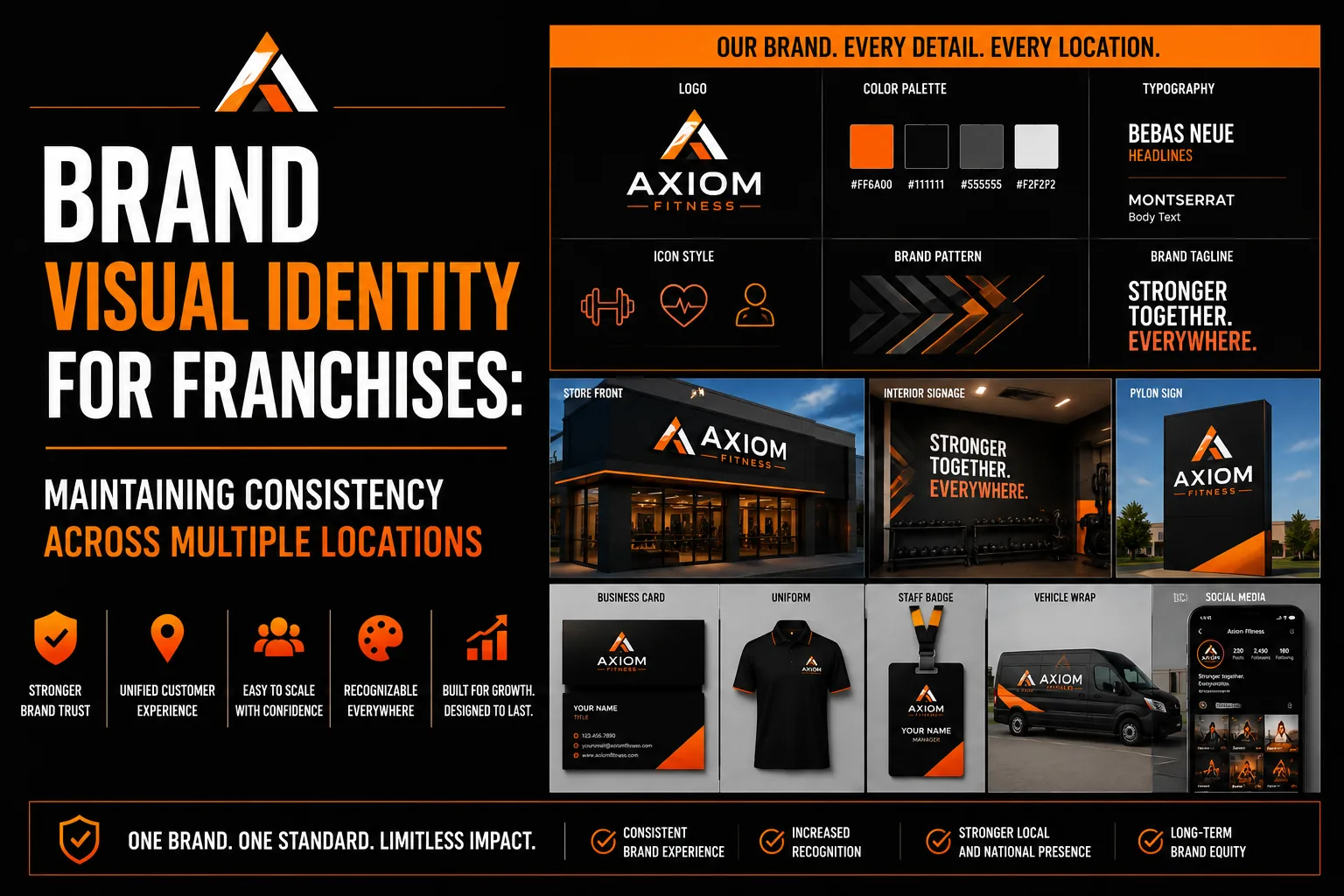
Brand Visual Identity for Franchises: Maintaining Consistency Across Multiple Locations
A franchise keeps its visual identity consistent by giving each location approved assets, practical templates and a clear review process. Define what must stay fixed and what can change locally. Store current files in one place, identify their versions and test supplier output before a campaign reaches several locations at once.
Why does consistency need an operating process ?
Most franchise brand inconsistency is not caused by franchisees who do not care about the brand. It is caused by systems that make it easier to produce non-compliant materials than compliant ones. When a franchisee needs a promotional flyer in a hurry and the brand asset library is difficult to navigate, when the approved templates are out of date, when there is no one to call with a quick design question, and when there is no clear consequence for non-compliance, the path of least resistance is to hire a local designer who recreates the brand from memory and produces something that is close but wrong in ways that compound across hundreds of simultaneous applications.
Solving franchise brand consistency is a systems design problem. It requires making compliant behavior the easiest available option, providing franchisees with the assets and templates they need before they need them, and creating a feedback loop that catches and corrects deviations early rather than after they have been in the market for months.
Which parts of brand management must be defined ?
Effective franchise brand consistency rests on three interconnected pillars. The first is a comprehensive brand standards document, specific, unambiguous, and complete enough that a designer who has never worked with the brand before can produce compliant materials from it alone. The second is a centralized, accessible asset library where franchisees can download every approved logo variant, template, and brand file in the format they need, without contacting the franchisor for each request. The third is an approval process for locally produced materials, fast enough that franchisees do not bypass it under time pressure, and specific enough in its feedback that approvals build franchisees’ brand knowledge rather than just controlling individual outputs.
What makes brand guidelines usable ?
Brand standards documents fail when they are too long to read, too vague to act on, or too technically demanding for the non-designer franchisee who needs to use them. A usable franchise brand standards document is organized by use case, what you need when you are ordering signage, what you need when you are producing print materials, what you need when you are posting on social media, rather than by design principle.
Each section must specify exact, actionable requirements. Color codes must be given in all four systems: Pantone, CMYK, RGB, and HEX. Logo minimum sizes must be given in specific millimeters or pixels, not vague language like “do not make it too small.” Prohibited uses must be illustrated with specific examples, not described in abstract terms. The most effective brand standards documents use a visual format with more examples and fewer words, showing compliant and non-compliant applications side by side produces clearer guidance than paragraphs of written rules.
How should you organize the shared asset library ?
A centralized brand asset library should be the single source of truth for every branded file in the franchise system. Every franchisee, every approved vendor, and every regional marketing team accesses the same library for every asset they need. The library must be organized so that a franchisee can find what they need in under two minutes without contacting anyone for help.
Effective franchise asset libraries organize files by application, signage, print materials, digital templates, social media, uniforms, rather than by file type. Within each application category, files are organized by format and size with clear labels. The library must be updated immediately when any brand element changes, and old versions must be archived or removed to prevent continued use of outdated assets.
Pre-built, locked templates for the most commonly produced marketing materials, promotional flyers, social media posts, local event signage, window graphics, dramatically reduce non-compliance by making it faster and easier for franchisees to produce a professional, on-brand result than to start from scratch with a local designer.
How can suppliers check colour consistency ?
Color consistency across multiple franchise locations, multiple vendors, and multiple production methods is one of the most technically challenging aspects of franchise brand management. The same brand color looks different on an interior painted wall, an exterior sign, a printed brochure, a digital screen, and an embroidered uniform, even when all are theoretically using the same color specification.
Providing vendors with Pantone codes is the most reliable way to communicate color intent for print applications. For digital applications, HEX codes and RGB values must be specified. For painted surfaces, specify the equivalent paint color in the most widely available paint system in your markets. Including physical color samples in your approved vendor kit and requiring vendor color approval before full production runs helps catch color drift before it reaches customers.
What should local teams know before ordering ?
How do you maintain brand consistency across multiple franchise locations?
Brand consistency requires three interconnected systems: a comprehensive brand standards document, a centralized asset library where franchisees download approved files, and an approval process for locally produced materials. The brand standards document must be specific enough that a franchisee cannot misinterpret it, vague guidelines produce inconsistent output regardless of intent.
What should a franchise brand standards document include?
It must include all logo variants in downloadable formats, exact color codes in Pantone, CMYK, RGB, and HEX, typography specifications, minimum logo size and clear space requirements, approved and prohibited color combinations, photography style guidelines, approved templates for commonly produced materials, and signage specifications including materials and illumination standards.
How should a franchisor handle a franchisee who violates brand standards?
Address violations through a defined escalation process. The first response should be educational, providing the correct asset and explaining why the standard exists. Repeated violations warrant a formal correction notice. The goal of enforcement is compliance, not punishment, most violations occur because franchisees lack access to the right assets or understanding of why the standard matters.
Should franchise locations be allowed to customize their branding for local markets?
Limited, structured local customization can improve franchisee buy-in without compromising brand integrity. The most effective approach is a modular brand system that specifies which elements are fixed (logo, primary colors, core typography) and which elements are flexible within defined parameters. Allowing customization of defined flexible elements satisfies franchisees’ desire to serve their local market while protecting system-wide recognition.
What is the cost of poor brand consistency across franchise locations?
Inconsistent materials can confuse customers and create avoidable rework. Give local teams the current assets, practical examples and a clear contact for design questions so corrections happen before production.